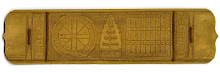
Here one more tribal art from The Metropolitan Museum of Art, New York
still under on going research to find out more details.
Date - 19th century
Geography - Mandalay?, Myanmar (formerly Burma)
Medium- Wood, various materials
Dimensions - H. 89.7 cm.; W: 87 cm.; D. 20.5 cm. for details see acc. card.ClassificationChordophone-HarpCredit LineThe Crosby Brown Collection of Musical Instruments, 1889Accession Number89.4.1465 a, b
Description
Place of origin - Burma (made)
Date -late 19th century (made)
Materials and Techniques - Black woollen cloth, appliquéd with painted silk, silver spangles and silver-gilt thread.
Credit Line - Given by Miss Eunice Frost OBE
Gallery location - In store
A standing female figure holding a cheroot. Dressed in the style of a court lady of the Konbaung Dynasty (1752-1885) Mandalay Court ca. 1880. It consists of three main elements - a hta-mein (the lower wrap around garment) which is made up of a central panel of an acheik-luntaya design, a waist band of faded pink finishing in a train of faded pink; a floral patterned checkered yinzi (the breast cloth) and a tightly fitting checked ein-gyi (jacket) with flaring khar-taung (waist-wings) and kalama-no (lapets). These are worn with open sandals. The lady's hair is dressed in a jewelled coil on top of her head falling in a long piece over her right should and she wears multiple necklaces, jewelled ear-tubes, bracelets and rings.
Descriptive line
Embroidered Burmese kalaga (hanging) of woollen cloth with an applique design representing a lady of the Mandalay Court ca. 1880, of coloured textiles (partly painted), imitation jewels, silver gilt thread and sequins. ca. late 19th century.
This portrait of an elegantly dressed lady displays the classic almost crescent-shaped maha-naphoo (royal forehead) which was the height of fashion at the Mandalay court during the time of Thibaw Min (r. 1878-1885). It was then adopted by dancers and the nouveaux riches until about 1900. The effect was obtained by painting the hairline black. Inf. Noel F. Singer June 2002
Place of origin - Burma (probably, made)
Date - ca. 1880 (made)
Materials and Techniques - Carved and painted wood, with a costume of dark orange silk embroidered with gold thread, sequins, pieces of mirror and glass beads.
This male puppet probably represents a prince at the court of the Konbaung kings of Burma and wears the elaborate court costume with its shaped, tailored and sumptuously decorated pieces which were worn layer on layer culminating in the costume which, when seen from a distance, created the image of a legendary heavenly apsaras (celestial nymph).
Bought from J.C. Irwin on RP/66/2084 for £86 with IS 3l to IS 35-1966
Collection code -IND
Dimensions
Current Location - Victoria & Albert Museum
Physical description
Bibliographic References (Citation, Note/Abstract, NAL no)John Lowry Burmese Art London Her Majesty's Stationery Office 1974; Pl. 38
Sylvia Fraser-Lu Burmese Lacquerware The Tamarind Press Bangkok 1985; p. 138
Ralph Isaacs & T. Richard Blurton Visions from the Golden Land - Burma and the art of lacquer. British Museum Press 2000; Catalogue number and plate 128; p.177; (Catalogue of Exhibition of Burmese Lacquerware at the British Museum; Summer 2000).
Historical significance
A kamawa-sa (part of burmese shrine)
Place of origin -Mandalay (probably, made) BurmaDate - ca. 1885 (made )
Materials and Techniques - Stiffened cloth, red lacquered and gilded wood ( manuscript cover )
Dimensions - Length: 52.5 cm , Width: 9.8 cm
Current Location - Victoria & Albert Museum, London
Museum number - IS.11:26 to N-1969
Gallery location - Buddhist Sculpture, room 18, case 3
Physical description
Nos 26 B to N
13 folios (kha-ga); single cord hole.
6 lines, 32 char., Pali. Burmese tamarind-seed large script in black lacquer.
Paginated with Burmese letters.
Interlines: decorated with snippets of gilt foliage.
Borders: decorated with gilt running acheik patterns.
Middle folio margins: (1.5 cm).; decorated with a repeating lotus pattern.
First folio recto: decorated with a series of 7 interlaced compartments filled with alternating deva and naga figures.
First folio verso: text within margins (11.5 cm) decorated with devas.
Second folio recto: mirrors preceeding side.
Penultimate folio verso: see first folio verso.
Final folio recto: mirrors preceeding side.
Final folio verso: see first folio recto.
Undated.
Nos. 26 & 26A
Pair of shaped kyan (binding boards); Decorated with wide margins of a leafy design and a series of 5 compartment with alternating hintha and deva figures [manuscript cover]
Descriptive line
A stiffened cloth Kamawa-sa (Burmese Buddhist Ms.) and pair of wood Kyan (binding boards). Pali text, tamarind seed script, lacquered and gilded with figurative and foliate decorative motifs. Late 19th or early 20th century.
Bibliographic References (Citation, Note/Abstract, NAL no)
John Lowry, Burmese Art, London Her Majesty's Stationery Office 1974, Pl. 1.
Ralph Isaacs & T. Richard Blurton, Visions from the Golden Land - Burma and the art of lacquer; British Museum Press 2000; Cat. & ill. 71
Attribution Note
No date but said to be found in 1885 at the palace in Mandalay.
Acquisition date1957
1 - Devamitra ( The Beloved of Gods )
ေဒဝ မိၾတ
2 - Harivikrama ( The Might of Visnu )
ဟရိ ဝိၾကမ
3 - Sihavikrama ( The Courage of Lion )
သီဟ ဝိၾကမ
4 - Suriyavikrama ( The Power of Sun )
သူရိယ ဝိၾကမ
5 -Crithuvikrama ( The Protection of Armour )
ျဂီထု ဝိၾကမ
6 - Jatratatavikrama ( The Terror of Race )
ဇၾတတတ ဝိၾကမ
7 - [A] dityavikrama ( The Glory of Sun Race )
အဒိတ် ဝိၾကမ
Object - Plaque
Place of origin - Burma (made)Date - late 15th century (made)
Artist - Unknown
Materials and Techniques - Glazed stoneware
Dimensions -
Height: 48 cm
Width: 35 cm
Depth: 14 cm
Current Location - Victoria & Albert Museum, London
Museum number- IS.2-1966
Physical description
Tile depicting the warriors of Mara. The pious king Dhammaceti (r.1472-92) of Pegu built a series of temples to honour the life of the Buddha. The most distinguished was the temple complex of Shwegugyi, built in 1476. It was decorated with an extensive series of large-scale glazed tiles, many of which illustrated the demonic warriors of Mara's army, sent to disrupt the Buddha's meditation immediately prior to his Enlightenment. This tile, with owl-headed figures bearing swords, is typical of this series.
Object history note - Gifted by Cyril Newman.Historical context note
An illustration of similar plaques is given in pl. 10 of "Note of a tour in Burma in March and April 1892" by Oertel, Rangoon, 1893. The caption states that they belong to the "Phayre Museum" (Rangoon) and that they are probably from Pegu.
A similar plaque is in the B.M. Both are illustrated in "Notes on Antiquities in Ramamadesa" by Sir Richard Camac Temple (in Indian Antiquary, 1893 Dec. Vol XII). From a series probably from the Shwegugyi Pagoda, Pegu and thus possibly, 15th century.
Pitt Rivers Museum, Oxford, has four more of this series, given by Richard Temple.
Descriptive line
Tile Depicting the Warriors of Mara, Glazed stoneware, 15th century, Pegu, Burma.
Bibliographic References (Citation, Note/Abstract, NAL no)
John Lowry " Burmese Art" Pl.21
B,M. Catalogue- Buddhism " Art and Faith"; 1985; pp 164; Pl.226.
John Guy " Ceramic Traditions of South East Asia" Singapore, Oxford University Press, 1989.
Attribution Note
Possibly from the Shwegugyi temple, Pegu, Burma.
Burmese Votive Tablets by Dr. Richard M. Cooler
The most numerous and, perhaps, the most intimate objects from the Pagan period are the clay votive tablets that were stamped out and signed by many kings and nobles. The creation of these tablets, each displaying at least one image of the Buddha and some including over 100 images, was thought to produce good merit for its maker. The incentive for their creation is not in doubt, like so much concerning the Pagan Period, because many donors wrote and signed their intentions on the back of the tablet. King Anawratha’s tablets state that “This Buddha was made, with his own hands, by Sri Maharaja Aniruddhadeva, with the object of emancipation [i.e. gaining Nirvanna]”. Anawratha’s tablets had his tablets inserted into religious foundations throughout his kingdom.
The face of the tablet often displays a Buddha in bhumisparsa mudra seated within a temple that is similar to the one constructed at Bodhgaya, India, where the Buddha achieved enlightenment. Two lines of Sanskrit in North Indian characters of the 10th to 11th centuries is often imprinted below the Buddha images. This is a statement of the Buddhist creed in its most compressed and basic form: “The Buddha hath the causes told, Of all things springing from causes, And also how things cease to be, Tis this the Mighty Monk proclaims”.
Although the use of votive tablets at Pagan continued a tradition that originated in India and some tablets found in the two countries are identical, it is clear that votive plaques were created at Pagan because bronze and clay molds have been discovered there. Also, the Pagan donors signed many of the plaques in script.
Verso writing states
tablet made by King Anawratha’s
wife, Oueen Chipe
Ref: http://www.seasite.niu.edu/burmese/Cooler/Chapter_3/Part4/Images/pagan_period_4.htm
Subject - Votive seal
Place of origin - Burma ( Made )Date - 9th- 10th Century ( Made )
Materials -Terracotta
Material and Techniques- Elliptical buff clay
Museum number- IS.130-199
Physical description - A votive seal with a seated Buddha expounding the law.
Dimension
Height: 8.8 cm
Width: 7.8 cm
Diameter: 2.5 cm
Descriptive line - A votive seal with a seated Buddha expounding the law, Pyu, Prome, Burma.
Production Type and Product Note -UniqueObject - Votive plaque
Materials -Terracotta
Techniques - Impressed
Place of origin - Pagan , Burma ( Myanmar )
Current Location - British Museum
Date - 13thC
Dimensions - Height: 19.5 centimetres
Description
Votive plaque. Buddha beneath a triple arch and a parasol, in the earth-touching gesture. The tree is shown by branches with the Bodhi leaf. The small surrounding Buddhas in pearled niches with indications of a tree above and around them are a series of twenty-eight predecessors of the 'historical' Buddha. Two ‘stūpas’ fill spaces at the top, and a line of Burmese characters runs at the bottom of the impression. Inscribed with Burmese characters. Made of impressed terracotta.
Inscriptions
Inscription Type: inscription
Inscription Script: Burmese
Inscription Position: bottom
Inscription Comment: A line of Burmese characters runs at the bottom of the impression.
Curator's comments
Zwalf 1985
Another example of Burmese votive plaques of Indian type shows the Buddha beneath a triple arch and a parasol, in the earth-touching gesture associated with Bodh Gayā. The tree is shown by branches with the unmistakable Bodhi leaf. The small surrounding Buddhas in pearled niches with indications of a tree above and around them are a series of twenty-eight predecessors of the 'historical' Buddha. Two ‘stūpas’ fill spaces at the top, and a line of Burmese characters runs at the bottom of the impression.
The Tablets of the Bagan period have inscriptions mention such names as below list, I have typed myanmar fond to compare and you are required to download zawgyione fond to view myanmar fond.
Aniruddha ( King ?1044-?1077 ) အနိ ႐ုႏၶ ( ၁၀၄၄ - ၁၀၇၇ )
Anantajayabikram ( Sam`pyan`) သံပ်င္အနႏၲဇယဗိၾကမ္
Ananda ( Thera ) အာနႏၵ
Taimila ဣတဲမိလ
Na` Gon` ငေဂါင္
Na` Chu`m ငဆုမ္
Na` Pay Pwam ငပယ္ပြမ္
Cipe ( Chief Queen ) စိေပမိဘုရားၾကီး
Ce Thoy No ေစေတာယ္ေနာ
Canduma`h (?Sam'pyan`) သံပ်င္စႏၵဳမား
Tiras တိရ္သ္
Tra'yya' (Sam`pyan`) သံပ်င္ၾတာယ်ာ
Tribhuvana'-dityadhammara`ja ( King Thiluin` Man` 1084- 1113 ) ၾတိဘုဝနာဒိ တ်ဓမၼရာဇာ ( ထိလိုင္မင္း ၁၀၈၄ - ၁၁၁၃ )
Tribhuvana`dityapavaradhammara`ja ( King Can'su' II, 1174-1211 ) ၾတိဘုဝနာ ဒိတ်ပဝရဓမၼရာဇ ( ဒုတိယ စည္သူမင္း ၁၁၇၄ - ၁၂၁၁ )
Tribhuvana`dityaavaradhammaraj'a ( King Can'su' I, 1113? - 1162 ) ၾတိဘုဝနာ ဒိတ်ပဝရဓမၼရာဇ ( ပထမ စည္သူမင္း ၁၁၁၃ - ၁၁၆၀ )
Trypa' ( Sam`pyan`) သံပ်င္ၾတာယ်ာ
Triloka'vatamsaka`maha`devi ( Chief Queen of Thiluin' Man ) ထိလိုင္မင္း မိဘုရားၾကီး ၾတိေလာကာဝတံသကာမဟာေဒဝီ
Diva`cariyena ( Thera) ေထရ ဒိဝါစရိေယန
Dhammara'japndita ( Thera ) ေထရဓမၼရာဇပ႑ိတ
Pi ( Kalan ) လလန္ ပိ
Puwa ( Kalan ) ကလန္ ပုဝ
Pintu` ( Sam`pyan`) သံပ်င္ ပိႏၲဴ
Pwon` ( Kalan ) ကလန္ ေပၼာင္
Ban'na'no ( Sam`pyan`) သံပ်င္ ဗညားေနာ
May Khray မယ္ျခယ္
May Pa` မယ္ပါ
Muggaliputta ( Thera ) ေထရမုဂၢလိပုတၱ
Mon` Uin` ေမာင္အိုင္
Mon` Keh Soau ေမာင္ေကးေသာ္
Mon` Khat ေမာင္ခတ္
Yassa ( Sam`pyan`) သံပ်င္ ယႆ
Ya`sohddhara`h ( Thera ) ယာေသားဒၶရာ
Yikhi` ယိခီ
La'n Yan` Len လါင္ယင္ေလန္
Vajra`bharanadeva (?King ? 1077- 1084 ) ဝျဇာဘရန ေဒဝ ( မင္း ၁၀၇၇- ၁၀၈၄ )
Visannara`c ( Sam`pyan`) သံပ်င္ ဝိသႏၷရာစ္
Sudhamma`h (Thera ) ေထရ သုဓမၼား
Sumedha ( Thera ) ေထရ သုေမဓ
Sri` Maha` Sa`lini` (? Queen ) မိဖုရားၿဂီီမဟာသာလိနီ
Among these names, Aniruddha was King of Arimaddhanapura ( Pagan ) in the 11th Century. Cipe of the same period claimed to be the Chief Queen ( Mahesi ), Perhaps she was Aniruddha's queen. Sri Maha Salini probably was of the royal family of Aniruddha as the prefixes Sri Maha to her names suggest. Divacariyena and Suddhammah were the names of two senior monks of that time.
Preiod - circa 1050-1100

Object- Votive Tablet
Title- Votive Tablet, 12th century
Date- 12th century
Place of origin - Pegu, Burma
Techniques-Terracotta, deeply impressed from an intaglio mould
Dimensions- 3 3/8 x 2 3/8 x 3/8 in. (8.6 x 6 x 1 cm)
Current Location- Los Angeles County Museum of Art (LACMA)
Museum number- M.91.237 ( Not currently on public view )
Note - Gift of Mr. and Mrs. Haskia Hasson (M.91.237)
The votive is not really sharp and clear but I think it's does not look like 12th Century. It could be 14th Century.
Here , one more votive tablet from Harvard Art Museum. This is very similar to the votive from Victoria & Albert Museum, so I believe need not to describe. I saw 3 line of script at the bottom of votive and if anyone could add more information, please feel free to left comments.Votive Plaque Depicting Seated Buddha, 12th Century
Harvard Art Museum/Arthur M. Sackler Museum, Gift of Mr. and Mrs. Max Loehr, 1964.2
Title-Depicting Buddha in Bhumisparsa Mudra
Date-11th century, reign of King Aniruddha
Techniques-Terracotta, deeply impressed from an intaglio mould
Place-Pagan, Burma
Dimensions-13.3 x 9.5 x 0.9 cm (5 1/4 x 3 3/4 x 3/8 in.)
Current Location- Harvard Art Museum/Arthur M. Sackler Museum, Louis Sidney Thierry Memorial Fund, 1981.34
Museum number- 1981.34
This clay votive tablet, reportedly found at Pegu, Burma (now Myanmar), depicts the Buddha seated beneath the tower of the Mahabodhi temple at Bodh Gaya, in eastern India. He is seated in the Bhumisparsa Mudra pose with his right hand in the gesture of touching or witnessing the earth (bhumisparsa mudra), the gesture which more than any other represents the moment of his enlightenment.
He is flanked by seated figures of the Bodhisattva Avalokitesvara on the left and right. The branches of the Bodhi tree, under which the Buddha achieved enlightenment, branch out from the central niche. In the upper part of the tablet are a number of small votive stupas (the funeral mound which housed the Buddha's relics and which became the symbol of his transcendental form and the primary Buddhist momument). At the bottom is the two lines of a Buddhist prayer in the devanagari script. Clay votive tablets of the Buddha, quotes from Buddhist texts, and divine figures represent a significant element of the archaeological record of early Buddhist sites in Pagan period.
I am not ready to describe the script and remain uncertain for the time being.
Mengoon pagoda from N.W (Mingun)
Posted by ေရွးျမန္မာ in Post Bagan- Ava ( Inwa ), Post Bagan- Konbaung Period

Physical description
This image shows the large square pagoda with huge cracks in the brick work running from the top of the building to the bottom.
Place of Origin - Burma
Date - August 1855 - November 1855 (photographed)
Artist/maker - Tripe, Linnaeus
Materials and Techniques - salted paper print froma waxed paper (calotype) negative
Object history note
This photograph was one of a series from 'Burma Views' which was presented to the V&A in July 1909 by Lady Ida Low, wife of Malcolm Low, Esq., of the Bengal Civil Service and daughter-in-law of General Sri John Low. As a member of the Council of India in 1857, Sir John Low received the Burma Views (1857) set on 15th April 1857.
This photograph was published in the album Burma Views 1857, by Captain L. Tripe, official photographer to the Government of India's Mission to Ava [Burma]. Tripe made over 200 photographs during this trip, and the captions to the images are thought to be a collaboration between Tripe and the secretary to the Mission to Ava, Henry Yule.
Tripe’s Burma Views were distributed widely and were very well received. Tripe sent 50 copies to Calcutta. Fourteen sets from these were distributed by the Government of India, including seven sets to members of the Mission to Ava, former capital of Burma. Twenty sets were ordered by the East India Company’s Court of Directors, and most were given to members of the Court. It is not known what happened to the remaining sixteen sets. Due to Tripe’s ownership of the negatives, he printed a selection of his photographs for further distribution. A set of 92 views of Burma was given to the King of Prussia, and more sets were given to the Madras Photographic Society and associated figures. Two hundred and ninety additional prints were offered for sale at 2 Rupees per print at Griffiths and Co., Madras.
Historical context note
In April 1855 Lord Dalhousie, governor general of India, advised on a political trip to Amerapoora, Burma following the annexation of Pengu (part of Burma) by the British after the 1852 Anglo-Burmese war. Tripe was sent to accompany the party in 1855 as official photographer. The photographs he made during his stay resulted in his album of 122 images, Burma Views, published in 1857. These photographs result from this project, and have Tripe’s original numbering and titles on their mounts.
Descriptive line
Photograph, 19th century, No. 97 from series 'Burma Views' by Linnaeus Tripe, 'Mengoon. Pagoda from N. W.', albumen print, Burma, 1855
Labels and date - Mengoon Pagoda
Mengoon (Mingun), 1790–1819
By Linnaeus Tripe (1822–1902)
Albumen print, 1855
Museum no. 1578-1909
This large brick pagoda was begun during the reign of King Bodawpaya but remained incomplete after his death in 1819. The brick base of the lower terrace is 36 metres high, one-third the size of the intended structure. In 1838 an earthquake reduced sections to rubble. [59 words]
Attribution Note
Edition number unknown. This print was probably made to go into the album 'Burma Views', of which 50 full sets were produced. Additional prints were produced by Tripe for different sets of Burma images.
Physical description
A distant view of the landscape, with the ruins of many pagodas and built structures in the foreground. White in colour, the Gauda-Palen pagoda stands out in the distance. The Irrawaddy river and mountains are in the background.
Place of Origin - Burma
Date - Burma - August 1855 to November 1855 (photographed)1857 (printed and published)
Artist/maker- Tripe, Linnaeus
Materials and Techniques - Salted paer print from waxed paper (calotype) negative
Object history note
This photograph was one of a series from 'Burma Views' which was presented to the V&A in July 1909 by Lady Ida Low, wife of Malcolm Low, Esq., of the Bengal Civil Service and daughter-in-law of General Sri John Low. As a member of the Council of India in 1857, Sir John Low received the Burma Views (1857) set on 15th April 1857.
See Registry files for papers on acceptance of gift.
See Dewan p.235 for listings of other copies of the same photograph elsewhere.
This photograph was published in the album Burma Views 1857, by Captain L. Tripe, official photographer to the Government of India's Mission to Ava [Burma]. Tripe made over 200 photographs during this trip, and the captions to the images are thought to be a collaboration between Tripe and the secretary to the Mission to Ava, Henry Yule.
Tripe’s Burma Views were distributed widely and were very well received. Tripe sent 50 copies to Calcutta. Fourteen sets from these were distributed by the Government of India, including seven sets to members of the Mission to Ava, former capital of Burma. Twenty sets were ordered by the East India Company’s Court of Directors, and most were given to members of the Court. It is not known what happened to the remaining sixteen sets. Due to Tripe’s ownership of the negatives, he printed a selection of his photographs for further distribution. A set of 92 views of Burma was given to the King of Prussia, and more sets were given to the Madras Photographic Society and associated figures. Two hundred and ninety additional prints were offered for sale at 2 Rupees per print at Griffiths and Co., Madras.
Historical context note
In April 1855 Lord Dalhousie, governor general of India, advised on a political trip to Amerapoora, Burma following the annexation of Pengu (part of Burma) by the British after the 1852 Anglo-Burmese war. Tripe was sent to accompany the party in 1855 as official photographer. The photographs he made during his stay resulted in his album of 122 images, Burma Views, published in 1857. These photographs result from this project, and have Tripe’s original numbering and titles on their mounts
Descriptive line
Photograph, 19th century, No.10 of series 'Burma Views' by Linneaus Tripe, 'Pugahm Myo. Distant View of Gauda-palen', salted paper print, Burma, 1855
Bibliographic References (Citation, Note/Abstract, NAL no)
Dewan, Janet. The Photographs of Linnaeus Tripe: A Catalogue Raisonné. Toronto: Art Gallery of Ontario, 2003, p.235.
Labels and date
Distant View of Gauda-palen (Gawdapalin)
Pugahm Myo (Bagan), 1180–1250
By Linnaeus Tripe (1822–1902)
In this panoramic view, Tripe shows the extent to which the ruins of pagodas and temples were scattered along the Irrawaddy River, sometimes to a depth of three miles. He captures the graceful quality of the Gawdapalin pagoda or ‘Throne of Obeisance’ as it rises above the other ruins. [49 words]
Albumen print, 1855
Museum no. 1500-1909
Attribution Note
Edition number unknown. This print was probably made to go into the album 'Burma Views', of which 50 full sets were produced. Additional prints were produced by Tripe for different sets of Burma images.
Shape - rectangular
Subjects depicted - Buddhist
Categories - Photographs; Buddhism; Architecture
Production Type and Product Note - Limited edition
Collection code - IND
Manuthiha, Guardian at the Shwe-Dagon Pagoda; Corner of great pagoda
Object - Photograph Place of origin - Burma ( photographed Date - 1852 Artist/ Maker - McCosh, John (Dr) ( photographer ) Material and Techniques - Calotype Gallery Location - Victoria & Albert Museum, London ( In Store ) Museum number - 85 : 300Physical description
This photograph shows a European man in uniform standing infront of a manuthiha, a seated creature with a human nead and the body of a lion.
Dimensions
Height: 15.8 cm (image)
Width: 12.7 cm (image)
Height: 33.2 cm (mount)
Width: 26.8 cm (mount)
Descriptive line
'Corner of great Pagoda' by John McCosh, calotype, Burma, 1850s
Labels and date
Manuthiha, Guardian at the Shwe-Dagon Pagoda
Rangoon (Yangon), About AD 600
By John McCosh (1805–85)
A manuthiha is a seated creature with a human head and the body of a lion. Believed to ward off danger, they are sometimes found guarding the corners of a pagoda. John McCosh was a doctor and amateur photographer stationed in Burma during the Anglo-Burmese War of 1852. This rare photograph is one of the earliest surviving images of the region. [60 words]
Albumen print, 1852–3
Museum no. 85,300
Shape - rectangular
Subjects depicted - Buddhist
Categories - Photographs; Buddhism
Collection code - IND
Manuthiha, Guardian at the Shwe-Dagon Pagoda; Corner of great pagoda
Object - PhotographPlace of origin - Burma ( photographed
Date - 1852
Artist/ Maker - McCosh, John (Dr) ( photographer )
Material and Techniques - Calotype
Gallery Location - Victoria & Albert Museum, London ( In Store )
Museum number - 85 : 300
Physical description
This photograph shows a European man in uniform standing infront of a manuthiha, a seated creature with a human nead and the body of a lion.
Dimensions
Height: 15.8 cm (image)
Width: 12.7 cm (image)
Height: 33.2 cm (mount)
Width: 26.8 cm (mount)
Descriptive line
'Corner of great Pagoda' by John McCosh, calotype, Burma, 1850s
Labels and date
Manuthiha, Guardian at the Shwe-Dagon Pagoda
Rangoon (Yangon), About AD 600
By John McCosh (1805–85)
A manuthiha is a seated creature with a human head and the body of a lion. Believed to ward off danger, they are sometimes found guarding the corners of a pagoda. John McCosh was a doctor and amateur photographer stationed in Burma during the Anglo-Burmese War of 1852. This rare photograph is one of the earliest surviving images of the region. [60 words]
Albumen print, 1852–3
Museum no. 85,300
Shape - rectangular
Subjects depicted - Buddhist
Categories
Photographs; Buddhism
Collection code
IND
Ruined Tazoung, Tsagain Myo (Sagain)
Object-Photograph
Place of origin -Sagai, BurmaDate -August 1855 to November 1855 (photographed)
1857 (printed and published)
Artist / Marker - Tripe, Linnaeus ( photographer )
Material and Techniques - Salted paper print from a waxed paper (calotype) negative
Gallery location - In Store, Victoria & Albert Museum
Museum number - 1511 - 1909
Physical description
This image is of a large wooden shrine. It has a tiered roof structure, the bottom section of the roof is badly damaged. Through the damaged roof and the missing wooden beams it is possible to see the the statue of a seated Buddha and attendant figues inside the shrine. There are several other pagodas and building in the background.
Dimensions
Height: 24 cm (within mount)
Width: 34.4 cm (within mount)
Height: 38 cm (mount)
Width: 49.5 cm (mount)
Object history note
This photograph was one of a series from 'Burma Views' which was presented to the V&A in July 1909 by Lady Ida Low, wife of Malcolm Low, Esq., of the Bengal Civil Service and daughter-in-law of General Sri John Low. As a member of the Council of India in 1857, Sir John Low received the Burma Views (1857) set on 15th April 1857.
See Registry files for papers on acceptance of gift.
See Dewan p.244 for listings of other copies of the same photograph elsewhere.
This photograph was published in the album Burma Views 1857, by Captain L. Tripe, official photographer to the Government of India's Mission to Ava [Burma]. Tripe made over 200 photographs during this trip, and the captions to the images are thought to be a collaboration between Tripe and the secretary to the Mission to Ava, Henry Yule.
Tripe’s Burma Views were distributed widely and were very well received. Tripe sent 50 copies to Calcutta. Fourteen sets from these were distributed by the Government of India, including seven sets to members of the Mission to Ava, former capital of Burma. Twenty sets were ordered by the East India Company’s Court of Directors, and most were given to members of the Court. It is not known what happened to the remaining sixteen sets. Due to Tripe’s ownership of the negatives, he printed a selection of his photographs for further distribution. A set of 92 views of Burma was given to the King of Prussia, and more sets were given to the Madras Photographic Society and associated figures. Two hundred and ninety additional prints were offered for sale at 2 Rupees per print at Griffiths and Co., Madras.
Historical context note
In April 1855 Lord Dalhousie, governor general of India, advised on a political trip to Amerapoora, Burma following the annexation of Pengu (part of Burma) by the British after the 1852 Anglo-Burmese war. Tripe was sent to accompany the party in 1855 as official photographer. The photographs he made during his stay resulted in his album of 122 images, Burma Views, published in 1857. These photographs result from this project, and have Tripe’s original numbering and titles on their mounts.
Descriptive line
Photograph, 19th century, No. 30 from series 'Burma Views' by Linnaeus Tripe, 'Tsagain Myo. Ruined Tazoung', albumen print, Burma, 1855
Bibliographic References (Citation, Note/Abstract, NAL no)
Dewan, Janet. The Photographs of Linnaeus Tripe: A Catalogue Raisonné. Toronto: Art Gallery of Ontario, 2003, p.244.
Labels and date
Ruined Tazoung
Tsagain Myo (Sagain)
By Linnaeus Tripe (1822–1902)
A tazoung is an open-sided wooden pavilion housing a shrine to the Buddha, to which worshippers take offerings. Unlike the grand pagodas and temples that Tripe usually photographed, this evocative image captures the serenity of the Buddha figure in what is probably a simple roadside shrine. There are numerous tazoungs like this in the Burmese countryside. [56 words]
Attribution Note
Edition number unknown. This print was probably made to go into the album 'Burma Views', of which 50 full sets were produced. Additional prints were produced by Tripe for different sets of Burma images.
Shape - rectangular
Subjects depicted -BuddhistCategories- Photographs; Architecture; Buddhism
Production Type and Product Note - Limited edition
Collection code - IND
Nagayoung Pagoda, Amerapoora (နဂါး႐ံုဘုရား၊ အမရပူရ)
Place of origin - Burma (photographed)
Date - 1855
Artist/Maker- Tripe, Linnaeus (photographer)
Materials and Techniques - Albumen print from waxed paper (calotype) negative
Museum number- 1534-1909
Gallery location: Victoria & Albert Museum , In store
This images shows the striking nagayoung pagoda. The large naga, or serpent, towers over the roof. There is an arched entrance to the left of the main structure. The sky area is very faint with very little colour tone.
This photograph was one of a series from 'Burma Views' which was presented to the V&A in July 1909 by Lady Ida Low, wife of Malcolm Low, Esq., of the Bengal Civil Service and daughter-in-law of General Sri John Low. As a member of the Council of India in 1857, Sir John Low received the Burma Views (1857) set on 15th April 1857. See Registry files for papers on acceptance of gift. See Dewan p.260 for listings of other copies of the same photograph elsewhere.
This photograph was published in the album Burma Views 1857, by Captain L. Tripe, official photographer to the Government of India's Mission to Ava [Burma]. Tripe made over 200 photographs during this trip, and the captions to the images are thought to be a collaboration between Tripe and the secretary to the Mission to Ava, Henry Yule.
Tripe’s Burma Views were distributed widely and were very well received. Tripe sent 50 copies to Calcutta. Fourteen sets from these were distributed by the Government of India, including seven sets to members of the Mission to Ava, former capital of Burma. Twenty sets were ordered by the East India Company’s Court of Directors, and most were given to members of the Court. It is not known what happened to the remaining sixteen sets. Due to Tripe’s ownership of the negatives, he printed a selection of his photographs for further distribution. A set of 92 views of Burma was given to the King of Prussia, and more sets were given to the Madras Photographic Society and associated figures. Two hundred and ninety additional prints were offered for sale at 2 Rupees per print at Griffiths and Co., Madras.
In April 1855 Lord Dalhousie, governor general of India, advised on a political trip to Amerapoora, Burma following the annexation of Pengu (part of Burma) by the British after the 1852 Anglo-Burmese war. Tripe was sent to accompany the party in 1855 as official photographer. The photographs he made during his stay resulted in his album of 122 images, Burma Views, published in 1857. These photographs result from this project, and have Tripe’s original numbering and titles on their mounts.
Photograph, 19th century, No. 53 from series 'Burma Views' by Linnaeus Tripe, 'Amerapoora. Nagayoung Pagoda', albumen print, Burma, 1855
Bibliographic References (Citation, Note/Abstract, NAL no)
Dewan, Janet. The Photographs of Linnaeus Tripe: A Catalogue Raisonné. Toronto: Art Gallery of Ontario, 2003, p.260.
Labels and date
Nagayoung Pagoda (Nagayon) Amerapoora (Amarapura), 1800–50 By Linnaeus Tripe (1822–1902)
The large naga, or serpent, towering over the roof gives this white stone pagoda its name. It shelters the central shrine containing a Buddha image, while two long nagas border the staircase. The pagoda symbolises the story of the Naga Mucalinda, who is said to have sheltered the Buddha during a storm.
Albumen print, 1855 Museum no. 1534-1909
Edition number unknown. This print was probably made to go into the album 'Burma Views', of which 50 full sets were produced. Additional prints were produced by Tripe for different sets of Burma images.
Categories -Photographs; Architecture; Buddhism
Collection code -IND
Colossal Statue of the Gautama close to the N.end of the wooden bridge
Object - Photographed
Place of origin - Burma (Photographed)
Date- 1855 Artist/Maker - Tripe, Linnaeus ( photographer ) Materials and Techniques- Salted paper print from waxed paper ( calotype )negative Current Location - Victoria & Albert Museum Museum number - 1527 - 1909 Gallery Location - In StorePhysical description
A colossal stone figure of the Buddha surrouned by trees and small zedi (stupas/pagodas).
Date
August 1855 to November 1855 (photographed)
1857 (printed and published)
Dimensions
Height: 249 mm (photographic print)
Width: 341 mm (photographic print)
Object history note
This photograph was one of a series from Burma Views which was presented to the V&A in July 1909 by Lady Ida Low, wife of Malcolm Low, Esq., of the Bengal Civil Service and daughter-in-law of General Sri John Low. As a member of the Council of India in 1857, Sir John Low received the Burma Views (1857) set on 15th April 1857.
See Registry files for papers on acceptance of gift.
See Dewan p.255 for listings of other copies of the same photograph elsewhere.
This photograph was published in the album Burma Views 1857, by Captain L. Tripe, official photographer to the Government of India's Mission to Ava [Burma]. Tripe made over 200 photographs during this trip, and the captions to the images are thought to be a collaboration between Tripe and the secretary to the Mission to Ava, Henry Yule.
Tripe’s Burma Views were distributed widely and were very well received. Tripe sent 50 copies to Calcutta. Fourteen sets from these were distributed by the Government of India, including seven sets to members of the Mission to Ava, former capital of Burma. Twenty sets were ordered by the East India Company’s Court of Directors, and most were given to members of the Court. It is not known what happened to the remaining sixteen sets. Due to Tripe’s ownership of the negatives, he printed a selection of his photographs for further distribution. A set of 92 views of Burma was given to the King of Prussia, and more sets were given to the Madras Photographic Society and associated figures. Two hundred and ninety additional prints were offered for sale at 2 Rupees per print at Griffiths and Co., Madras.
Historical context note
In April 1855 Lord Dalhousie, governor general of India, advised on a political trip to Amerapoora, Burma following the annexation of Pengu (part of Burma) by the British after the 1852 Anglo-Burmese war. Tripe was sent to accompany the party in 1855 as official photographer. The photographs he made during his stay resulted in his album of 122 images, Burma Views, published in 1857. These photographs result from this project, and have Tripe’s original numbering and titles on their mounts.
Descriptive line
Photograph, 19th century, No.46 from series 'Burma Views' by Linneaus Tripe, 'Colossal Statue of Gautama close to the N.end of the wooden bridge', salted paper print, 1855
Bibliographic References (Citation, Note/Abstract, NAL no)
Dewan, Janet. The Photographs of Linnaeus Tripe: A Catalogue Raisonné. Toronto: Art Gallery of Ontario, 2003, p.255.
Labels and date
Colossal Statue of the Gautama Buddha
Amerapoora (Amarapura), 1786
By Linnaeus Tripe (1822–1902)
Measuring 11.4 metres in height, this figure sits in the pose of bhumisparsha mudra, in which the Buddha calls the earth goddess to witness his enlightenment. It acquired the popular name ‘Left in the Sun Image’ as it did not originally have a roof over it. Now sheltered, it is known as the Taung-min-Gyi Buddha.
Subjects depicted - Tree, Pagodas; Buddha
Production Type and Product Note -Limited edition
Collection code - IND
Place of origin-Burma (photographed)
Date-1855
Artist/Maker- Tripe, Linnaeus (photographer)
Materials and Techniques-Salted paper print from waxed paper (calotype) negative
Museum number-1596-1909
Linneaus Tripe created one of earliest photographic records of Burma (Myanmar). His reputation as a photographer developed in India where he was employed in the East India Company army. Appointed to accompany the first British diplomatic mission to Burma in 1855, he was instructed to record information about the country. Tripe took over 100 images, demonstrating his skill in observation and composition. He used calotypes or paper negatives, which gave the prints a ‘soft-focus’ look.
Physical description
This image shows one large zedi (pagoda) with several smaller ones nearby. The main zedi is covered in a scaffolding of bamboo. There are trees surrounding the structures.
This photograph was published in the album Burma Views 1857, by Captain L. Tripe, official photographer to the Government of India's Mission to Ava [Burma]. Tripe made over 200 photographs during this trip, and the captions to the images are thought to be a collaboration between Tripe and the secretary to the Mission to Ava, Henry Yule.
Tripe’s Burma Views were distributed widely and were very well received. Tripe sent 50 copies to Calcutta. Fourteen sets from these were distributed by the Government of India, including seven sets to members of the Mission to Ava, former capital of Burma. Twenty sets were ordered by the East India Company’s Court of Directors, and most were given to members of the Court. It is not known what happened to the remaining sixteen sets. Due to Tripe’s ownership of the negatives, he printed a selection of his photographs for further distribution. A set of 92 views of Burma was given to the King of Prussia, and more sets were given to the Madras Photographic Society and associated figures. Two hundred and ninety additional prints were offered for sale at 2 Rupees per print at Griffiths and Co., Madras
Historical context note
In April 1855 Lord Dalhousie, governor general of India, advised on a political trip to Amerapoora, Burma following the annexation of Pengu (part of Burma) by the British after the 1852 Anglo-Burmese war. Tripe was sent to accompany the party in 1855 as official photographer. The photographs he made during his stay resulted in his album of 122 images, Burma Views, published in 1857. These photographs result from this project, and have Tripe’s original numbering and titles on their mounts.
Descriptive line
Photograph, 19th century, No. 115 from series 'Burma Views' by Linnaeus Tripe, 'Rangoon. Near view of the [Shwe Dagon] Pagoda', albumen print, Burma, 1855
Bibliographic References (Citation, Note/Abstract, NAL no)
Dewan, Janet. The Photographs of Linnaeus Tripe: A Catalogue Raisonné. Toronto: Art Gallery of Ontario, 2003, p.307.
Labels and date
Near View of the Shwe-Dagon Pagoda Rangoon (Yangon), About AD 600 By Linnaeus Tripe (1822–1902)
Shwe-Dagon is the most important pagoda and pilgrimage site in Myanmar. Here, the main zedi is covered in a scaffolding of bamboo. The structure was put up to enable the regilding of the zedi with gold leaf, an operation that routinely happens to this day. The trees in the foreground are today replaced with a wide forecourt dotted with smaller zedi and shrines. [63 words]
Albumen print, 1855 Museum no. 1596-1909
Associated names - Tripe, Linnaeus
Edition number unknown. This print was probably made to go into the album 'Burma Views', of which 50 full sets were produced. Additional prints were produced by Tripe for different sets of Burma images.
Photographs; Architecture; Buddhism
Production Type and Product Note
Limited edition