MANOUKTHIHA ( Lion with Guardian Head )  

Posted by ေရွးျမန္မာ in

sculpture sculpture sculpture sculpture
sculpture MANOUKTHIHA
Burma/Myanmar
Mandalay Period, 19th Century
Carved wood with white paint
h. 10 1/8 in., w. 4 in., d. 4 in.
Current Location - Northern Illinois University Collections
Gift of Konrad and Sarah Bekker, 1986
BC86.01.21

Seated figure with two lion-like bodies with tails and one human head crowned, joined at the torso so that there is only one set of front legs. The front legs are together and lower than rear. Wearing crown with broken finial and epaulets at ears and shoulder. Raised edges with horizontal marks along front and back legs. Holes where eyeballs are. Entire figure is painted white. Plain wood surface on base. Base is triangular-shaped with rounded corners. It is flat on top except for a dip in the front corner to allow for the long front legs.

Burmese Earth Goddess  

Posted by ေရွးျမန္မာ in

sculpture sculpture sculpture sculpture
sculpture EARTH GODDESS
Burma/Myanmar
Mandalay Period, 19th Century
carved wood lacquered and gilded with red lacquer on the bodice of the base
Current Location- Northern Illinois University Collections
h. 15 11/16 in., w. 6 7/8 in., d. 3 in.

Gift of Konrad and Sarah Bekker, 1986
BC86.01.18.00

Earth Goddess wringing her hair, wooden, lacquered and gilded. Red lacquer on bodice and base. Gilded figure is seated with her legs tucked up under her. Dexter arm is straight at her side holding her hair near the ground. The sinister arm grasps her hair on the top of her head. The hair itself is pulled up in one long strand and loops over and down the dexter side along the outside of the arm, the tip of the strand is held between thumb and forefinger of the dexter hand. Large ears with circular earrings. Large almond-shaped eyes. Lips are red. Wearing a long jacket with circular and flower motifs impressed on it. Bodice is red and skirt has vertical bands of geometric decorative motifs impressed onto it. Base is plain. Upper half is red and lower half is black. Red is painted over the black.

LOKANAT  

Posted by ေရွးျမန္မာ in

sculpture sculpture sculpture sculpture
sculpture LOKANAT
Burma/Myanmar
Mandalay Period
Carved wood, lacquered and gilded
h. 46 1/2 in., w. 18 3/4 in., d. 18 3/4 in.
Gift of Konrad and Sarah Bekker, 1987
BC87.01.07

Lokanat, also called Kaba Saung Nat, were also placed at the foot of the throne, regardless of whether it was occupied by the Buddha or a Burmese king. The sounds emanating from the foot chimes of these figures dispel anger and assure harmony in the throne room and kingdom, be it spiritual or temporal.

KINNARA & KINNARI  

Posted by ေရွးျမန္မာ in

KINNARA (MALE)

sculpture sculpture sculpture
sculpture KINNARA (MALE)
Burma/Myanmar
Mandalay Period, 19th Century
Carved wood, lacquered gilded with mirror inlay
h. 56 1/2 in., w. 22 5/8 in., d. 26 3/8 in.
Gift of Konrad and Sarah Bekker, 1987
BC87.01.01

Kinnari and Kinnara are mythical creatures who are thought to live in the Himalayas and who came to Burma with the spread of Buddhism. They are half-human, half-bird dancers, musicians, and choristers. Benevolent spirits, the Kinnara as well as their female consorts, the Kinnari, are known to watch over humans in time of danger. A particularly fine pair of monumental Kinnari and Kinnara figures in the Burma Collection are covered with a mosaic of colored glass, a technique typical of the Mandalay style.


KINNARI (FEMALE)

sculpture sculpture sculpture
sculpture KINNARI (FEMALE)
Burma/Myanmar
Mandalay Period, 19th Century
Carved wood, lacquered gilded with mirror inlay
h. 97 cm., w. 36 cm.
Gift of Konrad and Sarah Bekker, 1987
BC87.01.02

Kinnari and Kinnara are mythical creatures who are thought to live in the Himalayas and who came to Burma with the spread of Buddhism. They are half-human, half-bird dancers, musicians, and choristers. Benevolent spirits, the Kinnara as well as their female consorts, the Kinnari, are known to watch over humans in time of danger. A particularly fine pair of monumental Kinnari and Kinnara figures in the Burma Collection are covered with a mosaic of colored glass, a technique typical of the Mandalay style.

Burmese Orge ( BILU )  

Posted by ေရွးျမန္မာ in

sculpture sculpture sculpture sculpture
sculpture BILU
Burma/Myanmar
Mandalay Period
Carved wood, lacquered, with mirror inlay
h. 88 cm., w. 31.3 cm., d. 45.5 cm.
Current Location - Northern Illinois University
Gift of Konrad and Sarah Bekker, 1987
BC87.01.03.00

The Bilu is a large seated figure in human form with the face of an ogre. With legs tucked underneath and the right leg raised slightly off the ground, he sits upright and leaning slightly forward, head tilted slightly upward. Hands are brought together in front of the chest in an attitude of reverence. There is an indentation, perhaps for inserting something between the thumbs. The figure wears an elaborate costume carved in relief, lacquered, gilded and inlayed. The long sleeve jacket has a fish scale or lotus petal pattern in molded lacquer or thayo. There are three flares on each shoulder and four flares around them. A band crossing over the chest and in back is worn over the jacket and is carved and decorated with thayo and inlayed both in front and in back. The collar also is carved in wood and decorated with thayo and inlay. Bands on the upper arms close to the elbows are made of metal, which is red lacquered, gilded, and decorated with thayo bands. A sash-like strip runs across the lower back from behind each elbow and is carved wood, which has been lacquered and gilded. At the wrists molded thayo bands form either bracelet or elaborate cuffs. From the waist down over the gap between the legs and onto the base runs a three-tiered panel, inlayed and with thayo bands. In back of figure, cloth extends beyond hem of jacket to ground or base, covering foot and backside of figure. The headdress worn is fairly flat close to the head with a waisted column rising out of the center on top-of, which a closed fanlike shape extends upwards, and backwards with smaller petal shaped or leaf shaped green inlayed decorative motifs on the front and sides. Mirror inlay and thayo bands accentuate the face of the ogre. The eyes are painted in black lacquer over a carved indentation. A line runs from the eye across the side of the face curling up in a small loop and then curling down, each eye having the same design. Above the eyes, green inlaid floral or furlike extensions make the eyes more menacing. A silver drop-shaped silver mirror inlay is set between the eyes at the forehead. The top of the naturalistic nose is wrinkled in a snarl-like attitude. Two large fangs and the green inlay band and floral or fur like motif around the mouth emphasize the grimacing mouth. The chin also has designs of the floral or fur like motif which also appear along the side of the face behind the ears, the latter are also inlayed. The Adam’s apple is defined on the neck. On the back of the head black lacquer indicates hair. The base is carved from the same piece of wood as the figure. It is simply red lacquered. The base is a raised strip on which the front legs rest on and an arched strip supports the feet and buttocks. It appears that the base would have been carved continuously but was cut out along the sides. Thus underneath the figure would have been hollow within the base and partially up into the inside of the figure. On the inside another section appears to be carved out near the back and another piece of wood inserted, being smaller than the wide hole on the inside. This figure is one of a pair, see BC 87.1.4. It appears that this image is of higher rank, perhaps a general. This is apparent in the special headdress, which may be used to identify him, the elaborateness of his costume, which is also more ornate than BC 87.1.4, and the extensive use of inlay and thayo designs on the costume, the stance and perhaps the taller height. The majority of inlay is small circular pieces in silver, red and green. Around the neck there are pieces of red and silver, which are slightly larger circles, which are not flat but are raised slightly. These shapes also are placed in the center points of motifs but are used sparingly. There is diamond shaped pieces on the bands which cross in the back and that is the only place this shape occurs. Some of the pieces are petal shaped but still small and refined like the circles.

Journal of Burma Studies - Volume 13  

Posted by ေရွးျမန္မာ in


Journal of Burma Studies - Volume 13

Journal of Burma Studies

Kirichenko, Alexey, From Ava to Mandalay: Toward Charting the Development of Burmese Yazawin Traditions

Since the emergence of modern historiography of Burma (Myanmar), Burmese yazawin, or chronicles of kings, have been key scholarly sources. The most well-known of these chronicles are considered reliable after circa 1500 and provide a timeline of events for almost all research on precolonial Myanmar history. Despite this, we still have a quite vague understanding of textual genealogy and conditions in which these sources were produced, the foundations upon which they were constructed and the messages they carried. This article analyzes the corpus of Burmese yazawins and those narrative sources linked to yazawins that were instrumental in their compilation. It addresses the issues of typology and geneaology of yazawins, as well as the reconstruction of their development in terms of scope, structure, and conceptual focus. It challenges some historiographic stereotypes with regard to yazawins as a whole and the nature of individual sources in particular, and identifies a number of distinct yazawin traditions. The role of elites of royal cities of Ava, Taungngu, and Pagan in the production of yazawins is explored. Development of yazawin traditions is analyzed both as a kind of established textual activity with its own dynamics and as a function of changes in the organization of power and textual culture. Finally, the author suggests a number of tasks to be addressed in future research. All in all, the paper is conceived as a contribution towards the textology and hermeneutics of Burmese narrative sources and ideas in Myanmar in general.

Andrew Huxley, Three Nineteenth-Century Law Book Lists: Burmese Legal History from the Inside

Through the investigation of three Burmese law book lists by Maungdaung Sayadaw, Tha Dwe, and Kyaw Htun this article seeks to construct a narrative history of legal traditions. By breaking each list into smaller units and comparing the results a common core of Burmese legal history emerges. The lists, shed light on who the typical authors of a dhammathat were while items that appear on some, but not all, of the lists help indicate controversies that were still matters of live debate during the nineteenth century.

Ralph Isaacs, Rockets and Ashes: Pongyibyan as Depicted in Nineteenth-and Twentieth Century European Sources

This article describes the Burmese festival of pongyibyan, the ceremonies at the cremation of a senior monk, mainly by collating written accounts and photographs by Europeans who witnesses pongyibyan in the nineteenth and early twentieth centuries. Certain rites of the pongyibyan ceremony offer interesting parallels to accounts of the Buddha’s own funeral found in the Mahaparinibbana Sutta. This article cites descriptions of the preparation of the monk’s corpse by evisceration, embalming, lacquering, wrapping in cloth and gilding, including descriptions of both the simple inner coffin and elaborate outer coffin, and the mortuary chapel (neibankyaung) where the body lay in state awaiting cremation. The article depicts the architectural and symbolic significance of the tall funeral pyres with figures of mythical beings and the role of the sat-hsaya, the craftsman in bamboo and cut paper who built them as well offering a description of the lonswethi, the tug-of-war for merit. Numerous foreign observers reported the Burmese passion for rocketry. At least three types of rockets (don) were used at pongyibyan for kindling the funeral pyre. Rockets commonly caused injury or death to spectators, and were discouraged by the British colonial government.

Burma Studies Conference 2010: Burma in the Era of Globalization  

Posted by ေရွးျမန္မာ in

source : http://www.burma.niu.edu/burma/conferences/2010/index.asp

Burma Studies Conference 2010: Burma in the Era of Globalization
The coming International Burma Studies Conference will be held in France, at Universite de Provence, Marseille, 6th-9th July, 2010.The conference is co-organized by Institut de Recherche sur le Sud-Est Asiatique (IRSEA-CNRS), Ecole francaise d'Extreme-Orient (EFEO), Centre Asie du Sud-Est (CASE-CNRS), Institut national des Langues et Civilisations Orientales (INALCO) and Center for Burma Studies (NIU DeKalb IL USA).


We invite panel participants to focus their proposals on the theme of understanding Burma/Myanmar’s position vis-a-vis processes of globalization. How does globalization contribute to change – or not – in Burma and also to our perceptions of Burma? Such an overview should be consequent to a multidisciplinary and interdisciplinary approach by specialists in anthropology, sociology, linguistics, political science, economics, history and archaeology; as well as in religion, literature, art and architecture.
Interested participants are asked to organize and submit panel proposals with 500-word abstracts by 1 December 2009.
Individual papers, for which a 250 word abstract is requested, are also welcome and will be duly integrated into the conference sessions by the organizers. The deadline for the individual paper proposals is 30 March 2010.
In addition to the title and abstract of the proposed panels and papers, please include the contributors’ names and academic affiliations, mailing address, email address, and specify equipment needs for the presentations.
Location: Marseille, France (Direction)Dates: 6-9 July 2010Deadline for submission of panel proposals: 1 December, 2009 (CLOSED)Deadline for paper proposals (titles and abstracts): 24 April, 2010Email: burmastudies2010@gmail.com
Conference fee:Euros 180 prior to April 30, 2010Euros 220 thereafter
Contacts:Please send the requested information to:
Burma Studies Conference, 2010Université de ProvenceIRSEA-CNRS3, Place Victor HugoMarseille 13003, FranceEmail: burmastudies2010@gmail.com
top^Organizing Committee:
Conference co-chairs:Catherine Raymond, Director, Centre for Burma Studies, Northern Illinois University, DeKalb IL 60115 USAcraymond@niu.edu
François Robinne, Director Institute of Research on South-East Asia at Marseille (France) Francois.Robinne@univ-provence.fr
Co-conveners:Bénédicte Brac de la Perrière, Centre Asie du Sud-Est (CASE-CNRS), Parisbrac@vjf.cnrs.frhttp://www.cnrs.fr
Marie-Hélène CardinaudInstitut Nationale des Languages et Civilisations Orientales (INaLCO), Parismhcardinaud@yahoo.frhttp://www.inalco.fr
Jacques Leider, Ecole Française d’Extrême Orient (EFEO), Parisjacques.leider@education.luhttp://www.efeo.fr
Alice Vittrant, Université de Provence, Marseille/CNRS-Lacito Alice.Vittrant@univ-provence.frhttp://www.univ-provence.frhttp://lacito.vjf.cnrs.fr/
Gustaaf Houtman, Anthropology Today, Londonghoutman@gmail.comhttp://anthropologytoday.ning.com
Chargés de mission:Véronique André, Centre de Recherche et de Documentation sur l’Océanie (CREDO), Marseilleveronique.andre@univ-provence.frhttp://www.pacific-credo.fr
Louise Pichard-Bertaux, Maison Asie-Pacifique (MAP), Marseillelouise.bertaux-pichard@univ-provence.frhttp://sites.univ-provence.fr/wmap
For further information regarding the Conference, please visit our websites:http://www.grad.niu.edu/burma

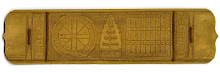
Burmese PARABAIK- SHAN SERMON BOOK  

Posted by ေရွးျမန္မာ in

Object - PARABAIK- SHAN SERMON BOOK
Place of origin - Burma/Myanmar
Materials - Paper, gold, gilded, silver and red mirror inlay
Dimension -h. 3 1/8 in. w. 5 in. l. 20 3/4 in.
Current Location - Northern Illinois University
Note-Gift of Konrad and Sarah Bekker, 1986 BC86.01.19.00

Parabaik. Shan Sermon Book. 1266 (i.e. 1904) Notes on various aspects of Buddhism. Written in Nissaya (bi-lingual) Pali-Shan (Burmese script). 266 Folds. Gold rectangular boards decorated on one side with silver and red mirror inlay and relief bands. A raised double border separates two strips of decorative motifs. The inner most strip of decoration consists of simple floral motifs in inlay and the outermost of a row of silver inlay interspersed with red mirror inlayed circles. Same design repeated on both covers. Edges of paper are gilded. Sheets of paper are left plain with Tai Yuan letters in red and black ink (?). Pages attached to one another in continuous folds accordion-style.