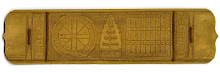
TAGUNDAING 19th C  

Posted by ေရွးျမန္မာ in

sculpture sculpture sculpture sculpture
sculpture sculpture sculpture
sculpture TAGUNDAING
Burma/Myanmar
Mandalay Period, 19th Century
Carved wood lacquered gilded with mirror inlay
h. 72 in., w. 14 1/2 in., d. 5 3/4 in. pagodas
Current Location -
Northern Illinois University Collection
Gift of Konrad and Sarah Bekker, 1987
BC87.01.13

The gallery’s small Tagundaing is a continuation of the ancient Indian practice of erecting monumental columns which symbolize the spread of the Buddhist faith. In Burma, these great Buddhist flagstaffs were raised in monastery compounds to celebrate the submission of local animistic gods to the triumphant Buddhist doctrine and law. Ranging anywhere from 60-80 feet in height, the Tagundaings were usually surmounted by ornamental mythical animals such as the Hintha bird, seen here atop the miniature Tagundaing. Frequently, the base of a large Tagundaing is set between piles carved in the form of mythical Thadya Nats. Originating from animistic practices, Thadaya and Thadya-min Nats are benevolent, and sometimes mischievous, cloud-dwelling spirits believed by some to be the ancestors of the Burmese people. At the foot of the flagstaff is the Earth Goddess wringing her hair. She is quite commonly represented associated with the flagstaff on ancient manuscripts, on woven manuscript wrapping ribbon sasygyo as well as on the oldest Tagundaing found in Pagan. Her placement there may indicate symbolically the recognition of her role in assisting the local Burmese population towards accepting Buddhism.

Mi-gyaung (Burmese Musical Instrument )  

Posted by ေရွးျမန္မာ in


Object Name - Mi-gyaung
Date - late 19th-century
Geography - Myanmar (formerly Burma)
DimensionsL. 54 in.
ClassificationChordophone-ZitherCredit LineThe Crosby Brown Collection of Musical Instruments, 1889Accession Number89.4.1473
Current Location - The Metropolitan Museum of Art, Newyork

In the 9th century several Burmese musicians were sent to the T'ang dynasty court. Among the instruments they presented to the emperor were the saung-gauk (harp), klene (mouth organ) and mi-gyaung, all chamber instruments. Mi-gyaung, means " crocodile-zither" in Burmese. Similar box zithers exist throughout Southeast Asia and, although the shape is not maintained, the reptilian name persists as chakhe in Thailand or kacapi in Indonesia and the Philippines.

Burmese Nat with 6 arms  

Posted by ေရွးျမန္မာ in

sculpture sculpture sculpture
sculpture sculpture
sculpture NAT
Burma/Myanmar
Sandstone
h. 57 cm., w. 27cm.
Current Location- Northern Illinois University Collections

Gift of Paul Cooler, 2003
BC2003.4.1

Burmese sandstone image of a nat (indigenous spirit), standing frontally, with six arms that once held attributes but no longer exist. Taungmagyi Nat, the Burmese cadet of the north who is the twin brother of the cadet of due south.

SUMEDHA  

Posted by ေရွးျမန္မာ in

sculpture sculpture sculpture
sculpture SUMEDHA
Burma/Myanmar
Mandalay Period, 19th Century
carved wood lacquered and gilded
Current Location- Northern Illinois University Collections


Gift of Konrad and Sarah Bekker, 1986
BC97.1.1

Monk prostrating before the Buddha offering his hair and body to prevent the Buddha’s feet from getting soiled. This monk lying in front of a Buddha is the ascetic Sumedha. He is usually portrayed prostrating before the Buddha Dipankara upon a muddy road. By stepping on Sumedha's body, Dipankara is able to cross the road easily, and he declares that Sumedha will reborn as Shakyamuni Buddha, in an aeon far in the future. You can see the depiction of this episode on the illustration of a Burmese manuscript from c.1800.

19th C Burma Ogre  

Posted by ေရွးျမန္မာ in

sculpture sculpture sculpture
sculpture BILU
Burma/Myanmar
Pre-Mandalay Period
Late 18th Century or early 19th Century
Carved wood, lacquered, with mirror inlay
h. 19 7/8 in., w. 11 13/16 in., d. 8 3/4 in.
Current Location- Northern Illinois University Collections

Gift of Konrad and Sarah Bekker, 1987
BC87.01.04.00

Elbow resting against and in front of dexter knee with forearm and hand curved in towards sinister heel. Sinister arm is bent with hand raised as if holding an object, which is now missing. A short wooden column joining upper leg and elbow supports elbow. Feet and toes are carved in detail. Wears regal attire and bracelets. Headdress and has flame-like motif on top. Large flame like motif extends upward and backward. Regal attire, bracelets and headdress were originally lacquered, gilded and inlayed. Panel of cloth hanging down from waist in front of figure rests on the ground and sinister leg lies over cloth panel. Face has ogre-like features. Nose is large and round. Large mouth with teeth bared and there are two large fangs extending upward over lip. Inlayed and gilded flame or leaf like patterns around the eyes and around entire mouth cover almost the entire face. Phalanges on ears were also originally gilded and inlayed. Seated on a base, which does not extend beyond figure, plain oval and flat 1-inch high disk. Inlay consists of large chunky pieces of glass cut in triangles, squares and rectangles. They are green, opaque and yellow. One of a pair, see BC 87.1.6. This image has no impressions on the chest as does BC 87.1.6 and only traces of white jesso-like substance appear on the legs/pants. There is a line of red lacquer 9r paint on the waisted part of the headdress. The thickness and chunkiness of the glass, its colors as well as the less sophisticated craftsmanship and the way the thayo surrounds the fragments may indicate that this pair of images are pre-Mandalay period, late 18th century or early 19th century.

MANOUKTHIHA ( Lion with Guardian Head )  

Posted by ေရွးျမန္မာ in

sculpture sculpture sculpture sculpture
sculpture MANOUKTHIHA
Burma/Myanmar
Mandalay Period, 19th Century
Carved wood with white paint
h. 10 1/8 in., w. 4 in., d. 4 in.
Current Location - Northern Illinois University Collections
Gift of Konrad and Sarah Bekker, 1986
BC86.01.21

Seated figure with two lion-like bodies with tails and one human head crowned, joined at the torso so that there is only one set of front legs. The front legs are together and lower than rear. Wearing crown with broken finial and epaulets at ears and shoulder. Raised edges with horizontal marks along front and back legs. Holes where eyeballs are. Entire figure is painted white. Plain wood surface on base. Base is triangular-shaped with rounded corners. It is flat on top except for a dip in the front corner to allow for the long front legs.

Burmese Earth Goddess  

Posted by ေရွးျမန္မာ in

sculpture sculpture sculpture sculpture
sculpture EARTH GODDESS
Burma/Myanmar
Mandalay Period, 19th Century
carved wood lacquered and gilded with red lacquer on the bodice of the base
Current Location- Northern Illinois University Collections
h. 15 11/16 in., w. 6 7/8 in., d. 3 in.

Gift of Konrad and Sarah Bekker, 1986
BC86.01.18.00

Earth Goddess wringing her hair, wooden, lacquered and gilded. Red lacquer on bodice and base. Gilded figure is seated with her legs tucked up under her. Dexter arm is straight at her side holding her hair near the ground. The sinister arm grasps her hair on the top of her head. The hair itself is pulled up in one long strand and loops over and down the dexter side along the outside of the arm, the tip of the strand is held between thumb and forefinger of the dexter hand. Large ears with circular earrings. Large almond-shaped eyes. Lips are red. Wearing a long jacket with circular and flower motifs impressed on it. Bodice is red and skirt has vertical bands of geometric decorative motifs impressed onto it. Base is plain. Upper half is red and lower half is black. Red is painted over the black.

LOKANAT  

Posted by ေရွးျမန္မာ in

sculpture sculpture sculpture sculpture
sculpture LOKANAT
Burma/Myanmar
Mandalay Period
Carved wood, lacquered and gilded
h. 46 1/2 in., w. 18 3/4 in., d. 18 3/4 in.
Gift of Konrad and Sarah Bekker, 1987
BC87.01.07

Lokanat, also called Kaba Saung Nat, were also placed at the foot of the throne, regardless of whether it was occupied by the Buddha or a Burmese king. The sounds emanating from the foot chimes of these figures dispel anger and assure harmony in the throne room and kingdom, be it spiritual or temporal.

KINNARA & KINNARI  

Posted by ေရွးျမန္မာ in

KINNARA (MALE)

sculpture sculpture sculpture
sculpture KINNARA (MALE)
Burma/Myanmar
Mandalay Period, 19th Century
Carved wood, lacquered gilded with mirror inlay
h. 56 1/2 in., w. 22 5/8 in., d. 26 3/8 in.
Gift of Konrad and Sarah Bekker, 1987
BC87.01.01

Kinnari and Kinnara are mythical creatures who are thought to live in the Himalayas and who came to Burma with the spread of Buddhism. They are half-human, half-bird dancers, musicians, and choristers. Benevolent spirits, the Kinnara as well as their female consorts, the Kinnari, are known to watch over humans in time of danger. A particularly fine pair of monumental Kinnari and Kinnara figures in the Burma Collection are covered with a mosaic of colored glass, a technique typical of the Mandalay style.


KINNARI (FEMALE)

sculpture sculpture sculpture
sculpture KINNARI (FEMALE)
Burma/Myanmar
Mandalay Period, 19th Century
Carved wood, lacquered gilded with mirror inlay
h. 97 cm., w. 36 cm.
Gift of Konrad and Sarah Bekker, 1987
BC87.01.02

Kinnari and Kinnara are mythical creatures who are thought to live in the Himalayas and who came to Burma with the spread of Buddhism. They are half-human, half-bird dancers, musicians, and choristers. Benevolent spirits, the Kinnara as well as their female consorts, the Kinnari, are known to watch over humans in time of danger. A particularly fine pair of monumental Kinnari and Kinnara figures in the Burma Collection are covered with a mosaic of colored glass, a technique typical of the Mandalay style.