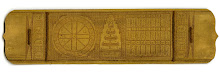
Object types - Plaque
Materials - Terracotta
Techniques- Moulded
Production place- Made in Burma (Pyu)
Date - 8thC-10thC (this date according to Guy 2002; Luce suggests 10th-11thC)
Description
Terracotta votive plaque, pressed from a mould and depicting the Buddha of the past, the historical Buddha, and a bodhisattva, according to Luce, Maitreya. The plaque is shaped in an arch-like structure and the three figures are seated on lotus thrones below which are decorative designs. On the reverse can be seen the veins of a leaf, probably of a peepul tree, on which the plaque has been pressed while drying.
Inscriptions
Inscription Type: inscription
Inscription Script: Pyu
Inscription Position: bottom
Inscription Language: Pyu
Inscription Transliteration: Budha mga: psu: khnu
Inscription Comment: for transliteration see Luce 1969; p100
Inscription Type: inscription
Inscription Script: English
Inscription Position: reverse
Inscription Language: English
Inscription Content: U Mya 105
Inscription Comment: written in red felt-tip pen. This probably refers to figure 105 in a book on terracotta votive tablets.
Dimensions
Height: 8 centimetres
Width: 6.5 centimetres
Condition - Good
Curator's comments
Bibliography: Guy 2002 Burma, Art and Archaeology; Chapter 3. Offering up a rare jewel. p.28, fig 3.7. BMP.


1 - Devamitra ( The Beloved of Gods )
ေဒဝ မိၾတ
2 - Harivikrama ( The Might of Visnu )
ဟရိ ဝိၾကမ
3 - Sihavikrama ( The Courage of Lion )
သီဟ ဝိၾကမ
4 - Suriyavikrama ( The Power of Sun )
သူရိယ ဝိၾကမ
5 -Crithuvikrama ( The Protection of Armour )
ျဂီထု ဝိၾကမ
6 - Jatratatavikrama ( The Terror of Race )
ဇၾတတတ ဝိၾကမ
7 - [A] dityavikrama ( The Glory of Sun Race )
အဒိတ် ဝိၾကမ

This votive seal shows a seated Buddha expounding the law. It originated in Prome, Burma (now Myanmar), and dates to the Pyu period (9th to 10th century).Subject - Votive seal
Place of origin - Burma ( Made )Current Location - Victoria & Albert Museum
Museum number- IS.130-199
Subject - Votive seal
Place of origin - Burma ( Made )Date - 9th- 10th Century ( Made )
Materials -Terracotta
Material and Techniques- Elliptical buff clay
Museum number- IS.130-199

Object- Votive Tablet
Title- Votive Tablet, 12th century
Date- 12th century
Place of origin - Pegu, Burma
Techniques-Terracotta, deeply impressed from an intaglio mould
Dimensions- 3 3/8 x 2 3/8 x 3/8 in. (8.6 x 6 x 1 cm)
Current Location- Los Angeles County Museum of Art (LACMA)
Museum number- M.91.237 ( Not currently on public view )
Note - Gift of Mr. and Mrs. Haskia Hasson (M.91.237)
The votive is not really sharp and clear but I think it's does not look like 12th Century. It could be 14th Century.

Object-Sculpture
Date-after 7th century
Techniques- Stone
Place-Burma
Dimensions- Height 35.5 cmWidth 17.8 cmDepth 7 cm
Place-Burma
Dimensions- Height 35.5 cmWidth 17.8 cmDepth 7 cm
Current Location - Victoria & Albert Museum
Museum number-IS.14-1983
This low relief of the Buddha with a monk's begging bowl in one hand and the other hand in the earth-touching posture (bhumisparsamudra) has the unadorned simplicity associated with the Pyu style of central Burma (now Myanmar). This image is related to a later series decorating the base of Yahandagu pagoda at Sri Ksetra, a monument which dates to the 10th century, immediately preceding the sacking of Hmawza (also known as Prome) by the forces of Pagan in the 11th century.

Object-Votive seal
Date-9th century-10th century
Techniques-Elliptical buff clay
Place-Burma
Dimensions- Height 9 cm, Width 7.8 cm, Diameter 2.5 cm
Current Location - Victoria & Albert Museum
Museum number-IS.130-1999
Current Location - Victoria & Albert Museum
Museum number-IS.130-1999
This votive seal shows a seated Buddha expounding the law. It originated in Prome, Burma (now Myanmar), and dates to the Pyu period (9th to 10th century).
Please let me post under Pyu-Mon for this Coin, even British museum said this is Arakan Coin and I agreed at the moment according to Pro: G H Luce and Dr Than Tun. Museum said it was 6th Century but 70% sure it will be earlier, I would like to say 4-6 th Century.
This is one more Arakan Coin from Brithsh Museum, whcih is pure silver and excellent condition. Please kindly check the below for Museum's original message and picture.


Burma, Pyu kingdom, city of Beikthano ( Vishnu )
AR ¼ unit (20 rati, 2.47 g),
Rrising sun coinage, 3-6th Century


I would like to say for this coin : Arakan, Sanda Wizaya, BE1072-1093 (1710-1731AD)
Tankah BE1075 (1713AD)
Pyu Coin from : Money, Markets, and Trade in Early Southeast Asia By Robert S. Wicks
I can't download the whole book, please click on the below link,
http://books.google.com/books?id=Qs1q9VEoEkoC&pg=PA116&lpg=PA116&dq=Ancient+Pyu+Coin&source=bl&ots=M0HRyzlqal&sig=ycD8Tw9cZ9uGuoz5Bl9QRwCL2sQ&hl=en&sa=X&oi=book_result&resnum=1&ct=result


Title: A Pyu Homeland in the Samon Valley: a new theory of the origins of Myanmar's early urban system Date of publication: March 2005 Description/subject: "Archaeological evidence suggests that between about 500 BC and 200 AD, a ricegrowing population was living in a densely settled system of small villages in the Samon Valley in Upper Myanmar. This area was at the crossroads of ancient trade routes. Wealth was accumulating due to agriculture and to access to the copper resources of the Shan hills, the semi-precious stone and iron resources of the Mount Popa plateau, and the salt resources of Halin. This wealth is evident in grave goods unique to the Samon region, which includes items traded from or inspired by Qin and Han Dynasty China. This paper will explore the possibility that the appearance early in the First Millennium AD of the walled Pyu cities of Maingmaw, Beikthano, Halin and Sriksetra, at remarkably consistent distances from the Samon Valley, may be a consequence of intra-regional population flow from the Samon area. While the Pyu cities shared cultural elements such as religious and decorative items, and coins bearing auspicious symbols, with neighbours including Dhanyawadi and Vesali on the west coast, the Dvaravati settlements of Thailand, and trade centres such as Oc Eo in Vietnam, their relationship to the landscape, to each other and to the Samon valley suggests that they formed a distinct economic and cultural system (Gutman & Hudson 2004).
" Author/creator: Bob Hudson Language: English Source/publisher: Proceedings of the Myanmar Historical Commission Golden Jubilee International Conference, Jan12-14, 2005, Yangon Format/size: pdf (642K) Date of entry/update: 01 December 2005
Please click on it http://acl.arts.usyd.edu.au/~hudson/BH2005Jan.pdf


Coin Hunting in Myanmar (Burma)
By Neil Sowards, D.D.
To most people Burma is on the other side of the world. It is sandwiched between India-Bangladesh, China, and Thailand. I have gone there seventeen times for my church. Since I collect foreign coins, I look for Burmese coins when I have time.
There are no dealers with shops like we have here and in Europe. In the tourist market there are stalls or booths about eight feet wide and twenty feet deep. None deal exclusively in coins but there are two which have a good selection of Burmese antiques and some coins. One of these, owned by Shwe Kyaw [not his real name], has only genuine antiques, while the other has a mixture, but will tell you which is really old and which are recently made for tourists.
Other stalls might have a few coins in a dish along with stamps and notes. Since it is technically illegal for tourists to buy old coins, they are out of sight but they will show them to you if you ask. All speak enough English to do business. There are also some antique shops with coins at two other locations in Yangon (Rangoon) but their selection is rather pitiful. Most say Shwe Kyaw has purchased all their good coins, as he regularly makes the rounds to these shops. So I end up buying most of my coins from him.
He is about retirement age and knows Burmese coins well. He has a display of Burmese coins that is rather extensive and maddening, because they are not for sale. He only sells his duplicates. He knows what is scarce and his prices are not steals but are fair for the rarity. I have purchased two coins from him listed as "rare" with no value given. I got to know him fairly well over the years. I asked him how many serious numismatists there were in Burma, a country of 45 million people. He thought a while, mentally counting them, and said four or five others.
He invited me to his home for dinner and had his son pick me. I thought he had lots of coins at home he wanted to sell me but I soon found out he just wanted to show me some of his prized pieces plus some very rare Burmese antiques. I got the feeling he really enjoyed talking with someone who appreciated what he had and does not press them to buy them. The Burmese meal was delicious.
The Japanese forced the Burmese to accept their paper occupation money during WWII which was issued in huge quantity and seems to be in every antique shop.
While usually I see the same old tired British India and smattering of very common world coins over and over again, there are times when interesting hoards show up.
One time they were demolishing a hundred year old buildings in the downtown area and a hoard of George V 10 Rupee notes was found under the roof. Apparently the hoard had been secreted at the start of World War II but the owner never returned for them. Most were water damaged and discolored. I bought a few. I still see them on every trip so they must not sell well.
One time I found about a dozen 1917 British India Uncirculated 2 anna coins at a reasonable price. They are the only uncirculated silver British India coins I have ever seen in Burma. This last time I found some uncirculated ¼ anna George V bronze coins in a tray with pure junk. They were beautiful but not cheap.
Another time I stumbled upon a street market which apparently only operated on Saturday nights. Small dealers would spread out a cloth and display their old stuff on it. I thought they were really optimistic that someone would buy any of their junk. But I did find several counterfeit ¼ anna bronze coins from British India. When they were made, a rupee was 33 cents and there were 12 annas to a rupee so these had a face value of ½ cent. It hardly seems worth the effort to counterfeit a ½ cent coin! Since it was illegal for them to be selling without a license, they could quickly grab the corners of their display cloth and gather up their merchandise and flee when the police came wanting bribes to leave them alone.
The most common foreign coin in Burma and Thailand is the counterfeit 1804 U.S. silver dollar in nickel. They seem to be everywhere and always with a good story. Most do not believe me when I tell them they are worthless.
Another time I found in a shop a very large lead coin 73 mm across and weighing 14 ounces. At that time I hadn’t seen M. Robinson’s book, The Lead Coins of Pegu and Tenasserim, so I didn’t know if it was a coin or a weight. I bought it on speculation and it turned out to be a good buy.
Another time I viewed some coins at a shop but they were overpriced. After I left, a man followed me and invited me to his apartment of view his coins. I followed him up a narrow, dark stair shaft wondering if I had made a big mistake. It did turn out he had a big lot of revenue stamped paper which I bought and a CMA medal from WWII. This medal was issued in error when a message from the marauders with CMA in it was interpreted as meaning Citation for Military Assistance when it really meant comma! One hundred were issued and they are quite scarce. He wanted $200 for it without its ribbon. I regretfully declined.
Outside of Rangoon coins can sometimes be found at the stalls at pagodas. Pegu, now called Bago, which in ancient days was Pyu, has stalls that have lead coins from 500 AD to about 1,000 AD. It is a matter of luck if you find any coins in Taunggyi, Inle Lake, Mandalay, or Bagan. I have purchased less than a dozen from these locations in seventeen visits because they mostly have worn out British India and 1948-90 Burmese coins which they value at a much higher price than they are worth.
While one will never get rich buying coins in Burma, it is an interesting place where one can turn up unlisted early coins. The people are wonderful and friendly.
Photo caption:
Top left: Kingdom of Pyu lead coin 500-800 AD, bird left.
Top right Kingdom of Funan, silver 190-550 AD, rising sun.
Center: Srekshetra silver 1/100 unit 750-832 AD unknown symbol
Bottom Right: Sanda Thudhamma Silver 1652 AD Burmese writing.
U. S. Dime is reference as to size.

Silver tanka of the Pyu kings
Shrikshetra, Burma (Myanmar)8th century AD
Indian symbolism reaches Burma
Shrikshetra, Burma (Myanmar)8th century AD
Indian symbolism reaches Burma
In the eighth century, eastern Burma was ruled by the Pyu peoples, who issued coins with designs derived from those of the kingdom of Arakan to the west. On this example, the obverse (front) of the coin shows a throne tied with royal diadems in the centre and surmounted by flames.
The reverse shows symbols associated with Indian deities and the more ancient Indian Creation myth. The dominant image is the symbol of shrivatsa, representing Shri, the goddess of wealth and good fortune. Inside this symbol is a mountain, representing Shiva, the god of contrasting forces (good and evil; fertility and asceticism). The mountain also represents the earth, rising out of the wavy lines of the ocean below. Above them, the moon (a circle) and sun (a star shape) signify the heavens. On the left is a thunderbolt, emblem of Indra, god of the heavens, and on the right, the conch shell associated with Vishnu, god of creation and preserver of the cosmic system.
J. Cribb, B. Cook and I. Carradice, The coin atlas (London and Sydney, Macdonald Illustrated, 1990)
J. Williams (ed.), Money: a history (London, The British Museum Press, 1997)
Theravada Buddhist Sculpture at Srikshetra
Most images of the Buddha are carved in high relief with a considerable stele backing. Several sets of these monumental images have been found arranged so that two triads face one another. This practice occurs only during the Pyu Period and may hearken back to the megaliths of a much earlier time.
A number of Buddha images were found within or outside the ancient city. A great number of clay votive tablets have come to light as well as several bronze molds that were used to stamp them out. These tablets were placed in the foundation and deposit boxes of stupas and temples during construction as a means to increase their sanctity as well as the spiritual merit of the donor. An example of this practice is the placement by King Anawratha of votive tablets within the Bawbawgyi stupa; each displays fifty small images of the Buddha.
Individual images at Srikshetra represent a number of events in Gautama Buddha’s life: The Birth, The Prince contemplating the Mysteries of Life, Meditation, one of the most elaborate presentations of the First Sermon to be found in Burma, Teaching with both hands in vitarka mudra, the Enlightenment using both right and left hands for earth touching, the earliest representation of the earth goddess in Burma in which she is shown with two long tresses of hair, the Miracle of Double Appearances, Overcoming the Nalagiri Elephant and Holding the alms bowl. In later presentations these events are often assigned much less importance and appear, if at all, within a small frame in a wall painting or as a background embellishment to the Buddha’s enlightenment.
Several bronze images believed to depict Maitreya have come to light, although they may be the bodhisattva Avalokiteshvara without his usual identifying marks. However, one of these curious images has the name Maitreya (incorrectly?) written on its base. The interest in Maitreya, the Buddha as well as the Bodhisattva of the Future (like Gautama Buddha, he is both a Theravada and Mahayanna deity), arises from a belief that he will return to save the world. This concern with Maiteya as a savior figure continues during the Pagan Period where it is an inspiration for creating votive plaques and for the creation of one of the world’s rare building types: pentagonal temples that have a shrine for each of the four Buddhas of the Past as well as one for Maitreya.
Most sculptures at Srikshetra are typically in high relief with a heavy stele backing, although some large single sculptures in the round have been discovered. One such sculpture from the Kan-wet-khaung-gon mound is made of stone and depicts the Buddha in a seated meditation posture with two hands placed on his lap. This is a particularly important image, not only because it is free standing but because it can be dated to the late 7th century by the bilingual inscription on its base. The inscription is fortunately not only in Pyu but Sanskrit as well, the script of which can be dated. This image is then one of the few dated benchmarks that can be used to establish a developmental chronology for Pyu sculpture.
Of particular interest is a cylindrical gilded silver casket found in the relic chamber of the Khin Ba mound. In a style derived from the North Indian Gupta style, it is embossed with the last four Buddhas of the present world cycle seated in the earth-touching posture with a standing disciple between each of them. The casket has a flat lid. A banyan tree rises from its center that was once adorned with metal twigs and leaves. Inscribed around the rim of the lid is a Pyu-Pali inscription in South Indian characters. The inscription identifies each Buddha by name as well as their disciples; it also records two names, probably of donors. A smaller reliquary casket shaped like a cube is without a lid or base and has a meditating Buddha seated on each face. Both reliquaries are executed in a precise and beautiful repousse technique.
It is not possible to give a detailed description of the Pyu style of image because so many different styles co-existed. Indeed, images that turn up and don’t fit any of the known Burmese styles, are frequently, and often inaccurately, dubbed “Pyu”.