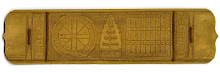
Object-Architectural tile
Note : Gift of Miriam and Ira D. Wallach Foundation, 1993 (1993.235.1)
Object - Standing Buddha,
Period - Pagan, 12th–13th century
Place of Origin - Burma
Materials - Bronze with silver inlay
Dimension - H. 19 7/8 in. (50.5 cm)
Current Location - The Metropolitan Museum of Art,
Although the Buddha's image is a frontal and static one, here the proportions of the figure and facial type have been altered to reflect local tastes. The head is unusually large and the hips wide. The body is highly conceptualized and has lost a close correspondence with the human form. The size of the head, width of the shoulders, and taper of the legs have all become exaggerated. The face is almost heart-shaped, with a broad forehead, wide eyes, long nose, upturned mouth, square jaw, and small chin. The monastic robes cling to the body and flare outward from the forearms. The robes do not resemble real fabric but instead cling to the Buddha as if they were transparent, revealing the upper hem of the skirt and the robust forms of the upper body. The Buddha makes the gesture of protection with his right hand and, in his left, holds the folded hem of his outer robe. The work is typical of sculptures produced in the Burmese Buddhist kingdom of Pagan, which was founded in the mid-eleventh century.
Burmese Votive Tablets by Dr. Richard M. Cooler
The most numerous and, perhaps, the most intimate objects from the Pagan period are the clay votive tablets that were stamped out and signed by many kings and nobles. The creation of these tablets, each displaying at least one image of the Buddha and some including over 100 images, was thought to produce good merit for its maker. The incentive for their creation is not in doubt, like so much concerning the Pagan Period, because many donors wrote and signed their intentions on the back of the tablet. King Anawratha’s tablets state that “This Buddha was made, with his own hands, by Sri Maharaja Aniruddhadeva, with the object of emancipation [i.e. gaining Nirvanna]”. Anawratha’s tablets had his tablets inserted into religious foundations throughout his kingdom.
The face of the tablet often displays a Buddha in bhumisparsa mudra seated within a temple that is similar to the one constructed at Bodhgaya, India, where the Buddha achieved enlightenment. Two lines of Sanskrit in North Indian characters of the 10th to 11th centuries is often imprinted below the Buddha images. This is a statement of the Buddhist creed in its most compressed and basic form: “The Buddha hath the causes told, Of all things springing from causes, And also how things cease to be, Tis this the Mighty Monk proclaims”.
Although the use of votive tablets at Pagan continued a tradition that originated in India and some tablets found in the two countries are identical, it is clear that votive plaques were created at Pagan because bronze and clay molds have been discovered there. Also, the Pagan donors signed many of the plaques in script.

11 - 13 Buddha Image Votive Tablet
Verso writing states
tablet made by King Anawratha’s
wife, Oueen Chipe
Ref: http://www.seasite.niu.edu/burmese/Cooler/Chapter_3/Part4/Images/pagan_period_4.htm

Object - Votive plaque
Materials -Terracotta
Techniques - Impressed
Place of origin - Pagan , Burma ( Myanmar )
Current Location - British Museum
Date - 13thC
Dimensions - Height: 19.5 centimetres
Description
Votive plaque. Buddha beneath a triple arch and a parasol, in the earth-touching gesture. The tree is shown by branches with the Bodhi leaf. The small surrounding Buddhas in pearled niches with indications of a tree above and around them are a series of twenty-eight predecessors of the 'historical' Buddha. Two ‘stūpas’ fill spaces at the top, and a line of Burmese characters runs at the bottom of the impression. Inscribed with Burmese characters. Made of impressed terracotta.
Inscriptions
Inscription Type: inscription
Inscription Script: Burmese
Inscription Position: bottom
Inscription Comment: A line of Burmese characters runs at the bottom of the impression.
Curator's comments
Zwalf 1985
Another example of Burmese votive plaques of Indian type shows the Buddha beneath a triple arch and a parasol, in the earth-touching gesture associated with Bodh Gayā. The tree is shown by branches with the unmistakable Bodhi leaf. The small surrounding Buddhas in pearled niches with indications of a tree above and around them are a series of twenty-eight predecessors of the 'historical' Buddha. Two ‘stūpas’ fill spaces at the top, and a line of Burmese characters runs at the bottom of the impression.
The Tablets of the Bagan period have inscriptions mention such names as below list, I have typed myanmar fond to compare and you are required to download zawgyione fond to view myanmar fond.
Aniruddha ( King ?1044-?1077 ) အနိ ႐ုႏၶ ( ၁၀၄၄ - ၁၀၇၇ )
Anantajayabikram ( Sam`pyan`) သံပ်င္အနႏၲဇယဗိၾကမ္
Ananda ( Thera ) အာနႏၵ
Taimila ဣတဲမိလ
Na` Gon` ငေဂါင္
Na` Chu`m ငဆုမ္
Na` Pay Pwam ငပယ္ပြမ္
Cipe ( Chief Queen ) စိေပမိဘုရားၾကီး
Ce Thoy No ေစေတာယ္ေနာ
Canduma`h (?Sam'pyan`) သံပ်င္စႏၵဳမား
Tiras တိရ္သ္
Tra'yya' (Sam`pyan`) သံပ်င္ၾတာယ်ာ
Tribhuvana'-dityadhammara`ja ( King Thiluin` Man` 1084- 1113 ) ၾတိဘုဝနာဒိ တ်ဓမၼရာဇာ ( ထိလိုင္မင္း ၁၀၈၄ - ၁၁၁၃ )
Tribhuvana`dityapavaradhammara`ja ( King Can'su' II, 1174-1211 ) ၾတိဘုဝနာ ဒိတ်ပဝရဓမၼရာဇ ( ဒုတိယ စည္သူမင္း ၁၁၇၄ - ၁၂၁၁ )
Tribhuvana`dityaavaradhammaraj'a ( King Can'su' I, 1113? - 1162 ) ၾတိဘုဝနာ ဒိတ်ပဝရဓမၼရာဇ ( ပထမ စည္သူမင္း ၁၁၁၃ - ၁၁၆၀ )
Trypa' ( Sam`pyan`) သံပ်င္ၾတာယ်ာ
Triloka'vatamsaka`maha`devi ( Chief Queen of Thiluin' Man ) ထိလိုင္မင္း မိဘုရားၾကီး ၾတိေလာကာဝတံသကာမဟာေဒဝီ
Diva`cariyena ( Thera) ေထရ ဒိဝါစရိေယန
Dhammara'japndita ( Thera ) ေထရဓမၼရာဇပ႑ိတ
Pi ( Kalan ) လလန္ ပိ
Puwa ( Kalan ) ကလန္ ပုဝ
Pintu` ( Sam`pyan`) သံပ်င္ ပိႏၲဴ
Pwon` ( Kalan ) ကလန္ ေပၼာင္
Ban'na'no ( Sam`pyan`) သံပ်င္ ဗညားေနာ
May Khray မယ္ျခယ္
May Pa` မယ္ပါ
Muggaliputta ( Thera ) ေထရမုဂၢလိပုတၱ
Mon` Uin` ေမာင္အိုင္
Mon` Keh Soau ေမာင္ေကးေသာ္
Mon` Khat ေမာင္ခတ္
Yassa ( Sam`pyan`) သံပ်င္ ယႆ
Ya`sohddhara`h ( Thera ) ယာေသားဒၶရာ
Yikhi` ယိခီ
La'n Yan` Len လါင္ယင္ေလန္
Vajra`bharanadeva (?King ? 1077- 1084 ) ဝျဇာဘရန ေဒဝ ( မင္း ၁၀၇၇- ၁၀၈၄ )
Visannara`c ( Sam`pyan`) သံပ်င္ ဝိသႏၷရာစ္
Sudhamma`h (Thera ) ေထရ သုဓမၼား
Sumedha ( Thera ) ေထရ သုေမဓ
Sri` Maha` Sa`lini` (? Queen ) မိဖုရားၿဂီီမဟာသာလိနီ
Among these names, Aniruddha was King of Arimaddhanapura ( Pagan ) in the 11th Century. Cipe of the same period claimed to be the Chief Queen ( Mahesi ), Perhaps she was Aniruddha's queen. Sri Maha Salini probably was of the royal family of Aniruddha as the prefixes Sri Maha to her names suggest. Divacariyena and Suddhammah were the names of two senior monks of that time.

Subject - Votive Tablet of Buddha Shakyamuni
Place of origin - Burma ( Myanmar )
Preiod - circa 1050-1100
Preiod - circa 1050-1100
Medium - Terracotta
Dimension - 5 1/2 x 4 3/8 in. (13.97 x 11.11 cm)
Current Location - Los Angeles County Museum of Art (LACMA)
Museum no - (AC1997.72.1) Not currently on public view
Special note - Gift of Mr. and Mrs. Denis Robinson
Here , one more votive tablet from Harvard Art Museum. This is very similar to the votive from Victoria & Albert Museum, so I believe need not to describe. I saw 3 line of script at the bottom of votive and if anyone could add more information, please feel free to left comments. Votive Plaque Depicting Seated Buddha, 12th Century
Harvard Art Museum/Arthur M. Sackler Museum, Gift of Mr. and Mrs. Max Loehr, 1964.2

Object-Votive Plaque (Sâccha)
Title-Depicting Buddha in Bhumisparsa Mudra
Date-11th century, reign of King Aniruddha
Techniques-Terracotta, deeply impressed from an intaglio mould
Place-Pagan, Burma
Dimensions-13.3 x 9.5 x 0.9 cm (5 1/4 x 3 3/4 x 3/8 in.)
Current Location- Harvard Art Museum/Arthur M. Sackler Museum, Louis Sidney Thierry Memorial Fund, 1981.34
Museum number- 1981.34
This clay votive tablet, reportedly found at Pegu, Burma (now Myanmar), depicts the Buddha seated beneath the tower of the Mahabodhi temple at Bodh Gaya, in eastern India. He is seated in the Bhumisparsa Mudra pose with his right hand in the gesture of touching or witnessing the earth (bhumisparsa mudra), the gesture which more than any other represents the moment of his enlightenment.
He is flanked by seated figures of the Bodhisattva Avalokitesvara on the left and right. The branches of the Bodhi tree, under which the Buddha achieved enlightenment, branch out from the central niche. In the upper part of the tablet are a number of small votive stupas (the funeral mound which housed the Buddha's relics and which became the symbol of his transcendental form and the primary Buddhist momument). At the bottom is the two lines of a Buddhist prayer in the devanagari script. Clay votive tablets of the Buddha, quotes from Buddhist texts, and divine figures represent a significant element of the archaeological record of early Buddhist sites in Pagan period.
I am not ready to describe the script and remain uncertain for the time being.
Title-Depicting Buddha in Bhumisparsa Mudra
Date-11th century, reign of King Aniruddha
Techniques-Terracotta, deeply impressed from an intaglio mould
Place-Pagan, Burma
Dimensions-13.3 x 9.5 x 0.9 cm (5 1/4 x 3 3/4 x 3/8 in.)
Current Location- Harvard Art Museum/Arthur M. Sackler Museum, Louis Sidney Thierry Memorial Fund, 1981.34
Museum number- 1981.34
This clay votive tablet, reportedly found at Pegu, Burma (now Myanmar), depicts the Buddha seated beneath the tower of the Mahabodhi temple at Bodh Gaya, in eastern India. He is seated in the Bhumisparsa Mudra pose with his right hand in the gesture of touching or witnessing the earth (bhumisparsa mudra), the gesture which more than any other represents the moment of his enlightenment.
He is flanked by seated figures of the Bodhisattva Avalokitesvara on the left and right. The branches of the Bodhi tree, under which the Buddha achieved enlightenment, branch out from the central niche. In the upper part of the tablet are a number of small votive stupas (the funeral mound which housed the Buddha's relics and which became the symbol of his transcendental form and the primary Buddhist momument). At the bottom is the two lines of a Buddhist prayer in the devanagari script. Clay votive tablets of the Buddha, quotes from Buddhist texts, and divine figures represent a significant element of the archaeological record of early Buddhist sites in Pagan period.
I am not ready to describe the script and remain uncertain for the time being.

Chris allowed me to post this Unique photo in my blog. He have taken this photo in V&M museum, because of unusual portion.
I can confirm that the " Mudra " is " Dhamacarkranmudra" .
Asanas is " Pralambana`sana ". This mudra and asanas have been confirmed that since Pyu, about 4-5 AD. As Chris said, this pieces is unusual but its' not rare.
ye dhamma` hetuppabuava`
tesam hetum tatha`gato
a`ha tesan` ca yo nirodho
evamva`di maha`samano
which is means
The condition which arise from a cause, of these the Tatha`gata has stated the cause, also the way of suppressing these same: this is the teaching of the Great Ascetic ( Buddha ).
Chris, Ancient traveller who loves art, reading, food( no meat or alcohol though), opera, cinema

Object-Sculpture
Date-12th century
Techniques-Stone
Place-Burma
Dimensions-Height 14.5 cm
Current Location- Victoria & Albert Museum
Museum number-IS.35-1988
This seated figure of Buddha is in the Pagan style. The art of Pagan was mainly devoted to Theravada Buddhism, which found its chief means of expression through the Buddha figure. Seated images often show him in meditative posture with the soles of both feet uppermost (vajrasana), against a semi-architectural background which sometimes includes two birds facing outwards and holding a sprig of foliage or a string of jewels in their mouths. Crowned figures also make their appearance for the first time during this period. Pagan is one of the most remarkable religious cities in the world. Between the conquest of Thaton in 1057 until Pagan was seized by the forces of Kublai Khan in 1287, about 13,000 temples, pagodas and kyaungs, and other religious structures were built at the site, a vast plain in central Burma (now Myanmar).
Museum number-IS.35-1988
This seated figure of Buddha is in the Pagan style. The art of Pagan was mainly devoted to Theravada Buddhism, which found its chief means of expression through the Buddha figure. Seated images often show him in meditative posture with the soles of both feet uppermost (vajrasana), against a semi-architectural background which sometimes includes two birds facing outwards and holding a sprig of foliage or a string of jewels in their mouths. Crowned figures also make their appearance for the first time during this period. Pagan is one of the most remarkable religious cities in the world. Between the conquest of Thaton in 1057 until Pagan was seized by the forces of Kublai Khan in 1287, about 13,000 temples, pagodas and kyaungs, and other religious structures were built at the site, a vast plain in central Burma (now Myanmar).

Object-Votive tablet
Title-The Twin miracles
Date-11th century-12th century
Techniques-Terracotta, deeply impressed from an intaglio mould
Place-Pagan, Burma
Dimensions-Height 7.375 inWidth 5.375 in
Current Location-Victoria & Albert Museum
Museum number-IM.305-1921
Museum number-IM.305-1921
This clay votive tablet, reportedly found at Tagaung, Pagan, northern Burma (now Myanmar), depicts the Buddha seated beneath the tower of the Mahabodhi temple at Bodh Gaya, in eastern India. He is seated in the lotus pose with his right hand in the gesture of touching or witnessing the earth (bhumisparsa mudra), the gesture which more than any other represents the moment of his enlightenment. He is flanked by standing figures of the Dipankara Buddha on the left and of Maitreya Buddha on the right. The branches of the Bodhi tree, under which the Buddha achieved enlightenment, branch out from the central niche. In the upper part of the tablet are a number of small votive stupas (the funeral mound which housed the Buddha's relics and which became the symbol of his transcendental form and the primary Buddhist momument). At the bottom is the single line of a Buddhist prayer in the devanagari script. Clay votive tablets of the Buddha, quotes from Buddhist texts, and divine figures represent a significant element of the archaeological record of early Buddhist sites in South East Asia

Date-12th century
Techniques-Green-glazed ceramic tile
Place-Burma
Dimensions-Height 26.5 cm , Depth 3.5 cm , Width 26.5 cm
Current Location : Victoria & Albert Museum
Current Location : Victoria & Albert Museum
Museum number- IS.127-1999
This green-glazed ceramic tile, dating to 12th century Burma (now Myanmar), may have been a wall plaque or tile, possibly from the base of a stupa, though this is not known for certain. It illustrates one of the stories of the Buddha's previous lives, known as the Jataka stories.
Credit line-Bequeathed by Alex Biancardi

Object : Sculpture
Date : ca. 10th century
Techniques : Cast copper alloy, with gilding
Place :Bagan, Burma
Dimensions : Height 7.25 in , Width 4.75 in ,
Current Location : Victoria and Albert Museum
Museum number:IM.39-1922
Current Location : Victoria and Albert Museum
Museum number:IM.39-1922
This Buddhist devotional image, probably commissioned for donation to a temple at Pagan, depicts a male figure, probably the Bodhisattva Avalokitesvara, seated in the dress and posture of 'royal ease'. This unique Buddhist image is an iconographic rarity in that it may be dated as late as the 10th or 11th century; but it represents the work of craftsmen working in the earlier tradition.

Object: Relief panel
Title: Brahma
Date: 11th century
Techniques:Grey sandstone, with traces of yellow pigment
Place: Bagan, Burma (possibly)
Dimensions : Height 30.5 cm, Width 22.2 cm (base),Museum number
Current Location : Victoria and Albert Museum
ID - IM.39-1917
ID - IM.39-1917
Relief panel of the Trimurti, a triad of the Hindu gods Brahma, Vishnu and Siva, who represent the creative, preservative and destructive principles. The panel is carved in high-relief with a figure seated cross-legged and with palms joined together near the breast. The three faces turn to the front and to each side, their ribbed hair braided into three elaborate cone shapes with a lotus finial resting upon them. Except for the headgear, the sculpture is devoid of any other ornamentation or attribute. The upper torso of the image is bare, but the lower part of the body is clad. The hand and seating postures, as well as long earlobes, are notable for their Buddhist influence.
The exact provenance of this panel is uncertain. It was one of a series collected by Dr J. Anderson, who travelled through upper Burma in 1869 on the first British Expedition to Yunnan and bequeathed to his widow, Mrs G. S. Anderson. It has also been suggested that it could have originated in Eastern Bengal.

12th century AD..... Bagan or Pala
The Buddha emerging from a lotus-flower
Both stone and metal images were made during the Pala dynasty in eastern India (about the eighth to the twelfth century AD). While the stone reliefs are often up to two metres high, metal images such as this one are rarely more than twenty centimetres high. They were placed on altars within a monastery or temple. As they are more portable, many were carried further afield to Tibet, Burma and Indonesia.
This object is a small shrine in the form of a lotus flower. The lotus is a common symbol in all Indian religions and many images sit or stand on one. The lotus is a metaphor for purity for it grows out of mud yet remains untouched by it. The lotus flower also opens and closes its petals each day, and thus symbolizes the endless cycle of life and death. The petals of this metal lotus shrine open to reveal the Cosmic Buddha Akshobhya at the centre. In front of him is his symbol the vajra (thunderbolt). On the inside of each petal are eight bodhisattva. Deities support the lotus from beneath. The inscription around the base is a dedication by a Buddhist layman.
W. Zwalf (ed.), Buddhism: art and faith (London, The British Museum Press, 1985)
Eastern Pala Dyansty is quite influence to Bagan as we knew, but if we can read the ancient inscreption which is wrote on base of mandala could indentify Pala or Bagan.

Bagan 10th C
Dimensions
Height 33 cmWidth 19 cmDepth 7.5 cm
Museum number ( Victoria & Albert Museum )
IS.13-1983
This sculpture represents a famous incident in the life of the Buddha when he subdued the drunk and enraged elephant Nalagiri which had been unleashed on him by the evil king Ajatasattu. Attendant monks look on while the newly tamed elephant kneels before the Buddha. This relief was excavated, together with others illustrating the different scenes from the Buddha's life, in the vicinity of the Shwe-nyaung-bin-yo monastery at Hmawza, Burma (now Myanmar) in 1938-9. Stylistically these reliefs appear to provide the bridge between the Pyu art of the ancient Sri Ksetra and the Mon-Burmese art of Pagan.
The question is....... Found in 1938 but who bring out of Burma and How ?
Dimensions
Height 33 cmWidth 19 cmDepth 7.5 cm
Museum number ( Victoria & Albert Museum )
IS.13-1983
This sculpture represents a famous incident in the life of the Buddha when he subdued the drunk and enraged elephant Nalagiri which had been unleashed on him by the evil king Ajatasattu. Attendant monks look on while the newly tamed elephant kneels before the Buddha. This relief was excavated, together with others illustrating the different scenes from the Buddha's life, in the vicinity of the Shwe-nyaung-bin-yo monastery at Hmawza, Burma (now Myanmar) in 1938-9. Stylistically these reliefs appear to provide the bridge between the Pyu art of the ancient Sri Ksetra and the Mon-Burmese art of Pagan.
The question is....... Found in 1938 but who bring out of Burma and How ?

This is from Los Angeles County Museum of Art,USA. There is only a few pieces from Burma in this museum. This Standing Buddha is Late Bagan Period 13-14th C, Early Ava Period.
For full informations about this statue please click on below
http://collectionsonline.lacma.org/mwebcgi/mweb.exe
Pagan, the most important historical site in Burma, lies within a major bend of the Irrawaddy River where its east-west course turns and flows south. This capitol city, constructed entirely on the left bank of the river, is in the most arid part of the dry zone of Central Burma. Founded at sometime before the 9th century AD, Pagan was the capitol of the first Burmese kingdom from the 11th-14th centuries after its first great ruler, King Anawrahta, politically consolidated all of central Burma by conquering both the Pyu and the Mon peoples. Art and Architecture flourished during the Pagan Period and classic models were established that were copied by later kingdoms
Bagan (Pagan)is my favourite part & I HAVE SO MANY PICTURES/INFO/THESES/NOTES AND ...